

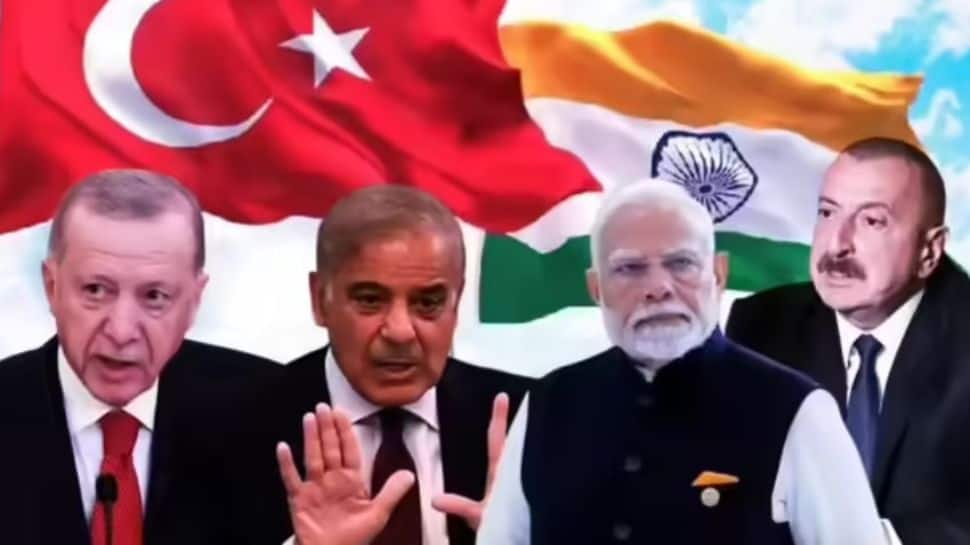
A complex web of geopolitical interests, historical ties, and strategic alignments has fueled recent tensions between India and a growing axis involving Turkey and Azerbaijan. While economic exchanges exist, both nations are increasingly adopting policies that run counter to India’s strategic objectives, largely driven by their strong support for Pakistan.
Turkey’s commitment to Pakistan has been particularly highlighted following India’s ‘Operation Sindoor.’ After a deadly terrorist attack in Jammu and Kashmir, India launched strikes against nine terror targets within Pakistan-administered territory. Ankara’s response was swift condemnation, with President Erdoğan expressing solidarity with Pakistan and offering diplomatic assistance. India’s Ministry of External Affairs publicly urged Turkey to curb its support for cross-border terrorism and take credible actions against alleged terror networks.
The Turkey-Pakistan relationship is reinforced by historical and ideological commonalities, often articulated as ‘Islamic solidarity.’ Turkey has consistently supported Pakistan on the Kashmir dispute. This ideological bond is complemented by significant military cooperation, including the supply of Turkish drones to Pakistan. India has reported the use of these drones in infiltration attempts and hostile actions, raising alarms about foreign military hardware fueling regional conflicts.
Azerbaijan has similarly aligned itself with Pakistan, condemning India’s military operations and advocating for a peaceful resolution. This stance is intrinsically linked to the strategic partnership between Turkey and Azerbaijan, formalized by the 2021 Shusha Declaration. This pact fosters joint defense capabilities, military drills, and economic collaboration, particularly through the “Middle Corridor” initiative.
Azerbaijan’s opposition to India is also influenced by New Delhi’s growing defense ties with Armenia, Azerbaijan’s adversary in the Nagorno-Karabakh conflict. India’s supply of advanced weapon systems to Armenia is a significant point of contention for Baku.
The emergence of the ‘Three Brothers’ alliance—a trilateral grouping of Turkey, Azerbaijan, and Pakistan—represents a consolidated front. This bloc engages in joint military exercises, mutual diplomatic support, and backing of each other’s regional claims, posing a collective challenge to India’s strategic interests.
The geopolitical ramifications for India are substantial. Public sentiment has led to calls for boycotts of Turkish and Azerbaijani tourism and businesses. India has responded with economic measures, such as revoking security clearances for a Turkish airport services firm. Diplomatic signals have also been issued, with India stressing the need for bilateral relations to respect its ‘core concerns,’ a veiled reference to Turkey’s military ties with Pakistan. Azerbaijan has also accused India of obstructing its SCO membership bid, framing it as retaliation for its support of Pakistan.
For Turkey, this alignment serves to enhance its influence in the Muslim world and project power. For Azerbaijan, it strengthens regional alliances and counters India’s increasing presence in the South Caucasus. India perceives this tripartite coalition as a deliberate strategy to contain its influence across South Asia and beyond.
The opposition from Turkey and Azerbaijan is rooted in a combination of historical alliances, ideological alignment with Pakistan, and pragmatic geopolitical ambitions. Their institutionalized cooperation has led to a more confrontational approach, especially in light of recent India-Pakistan tensions. India is actively seeking to counterbalance this axis by bolstering ties with Armenia and other regional powers, but the strategic friction with the Turkey-Azerbaijan bloc remains a significant and evolving challenge.