

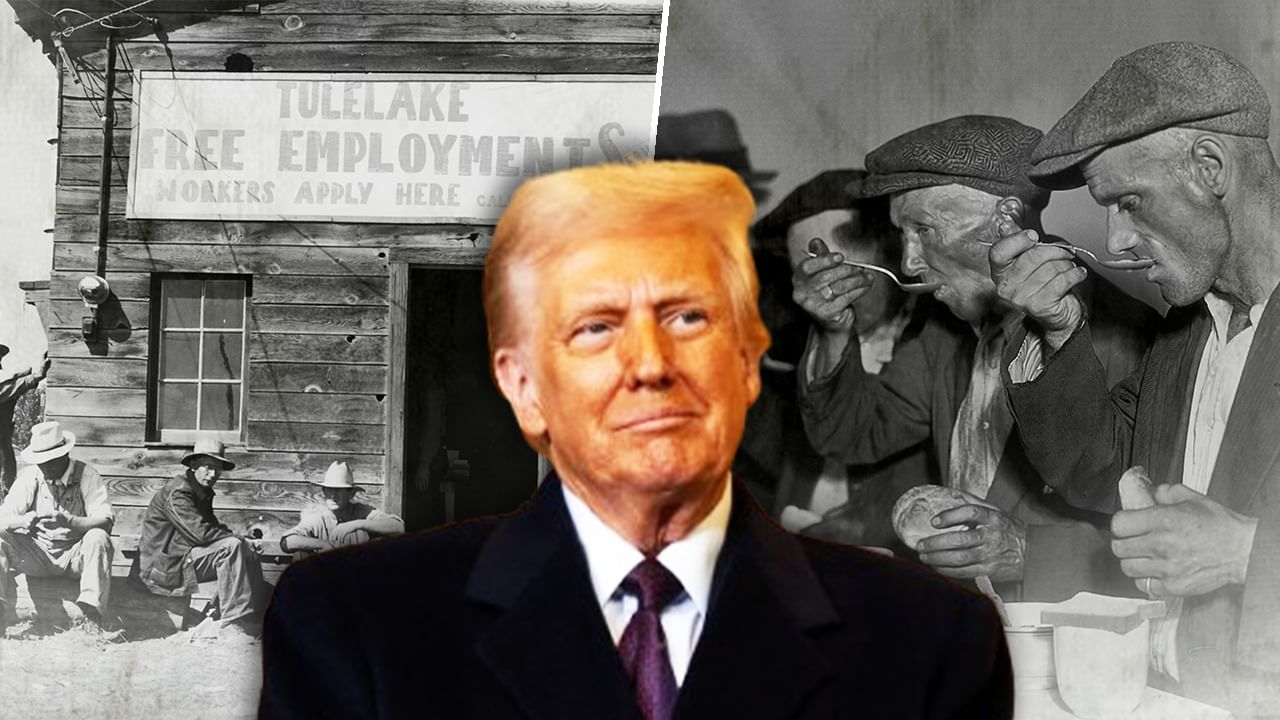
President Donald Trump’s economic warnings, spurred by new tariffs, have led to a review of the 1929 Great Depression, which caused a sharp decline in global production, income, trade, and employment. The period brought widespread hunger, poverty, and caused numerous business failures, pushing many to the brink.
The origins of the Great Depression can be found in the period following World War I. The war disrupted the global order and the international financial system. The U.S. and Japan expanded their manufacturing capacity after the war, leading to oversupply and economic losses for manufacturers.
Agriculture also suffered. Advancements after the war led to increased crop yields, causing a decline in grain prices on international markets. Farmers were unable to cover their production costs. To maintain their income, farmers increased production, which worsened the price collapse and drove the agricultural sector towards financial ruin.
The ‘Black Tuesday’ stock market crash on October 24, 1929, marked a critical moment. The New York Stock Exchange plummeted 50%, and corporate profits dropped by over 90%, starting a cascade of economic decline.
The US’s post-war lending to European allies deepened the economic situation. The decision to halt lending in 1929 caused financial instability worldwide. This decision contributed to the collapse of European banks and the devaluation of currencies worldwide, with Latin America also experiencing economic turmoil.
As the Depression intensified, American banks ended lending and enforced debt recovery. This severely impacted farmers, the middle class, and industrialists, plunging many into financial difficulties. Many families were unable to meet their financial obligations, resulting in the repossession of homes and vehicles.
The economic crisis led to the closure of thousands of banks and over 100,000 businesses. This resulted in mass unemployment. The unemployment rate increased rapidly, from 1.6 million in 1929 to 14 million by 1933.
Malnutrition and starvation became prevalent. In 1931, approximately 100 people died of starvation in New York hospitals, with countless others succumbing to diseases related to malnutrition. A lack of access to medical care worsened the situation. In New York, a large percentage of children suffered from malnutrition.
As a consequence, many Americans were forced out of their homes. By 1932, over 250,000 people were unable to keep up with their mortgage payments. Those who could not meet rent or mortgage obligations were evicted, resulting in homelessness. Basic necessities became out of reach.
Throughout several cities, shantytowns known as ‘Hoovervilles’ grew, reflecting public dissatisfaction with President Hoover. Desperate individuals resorted to extreme measures, including intentionally getting arrested to secure essentials like shelter and food.
The Great Depression lasted over a decade, with conditions improving by 1939. The outbreak and expansion of World War II boosted production, provided employment for women, and led to the recruitment of unemployed men, finally ending the depression.