

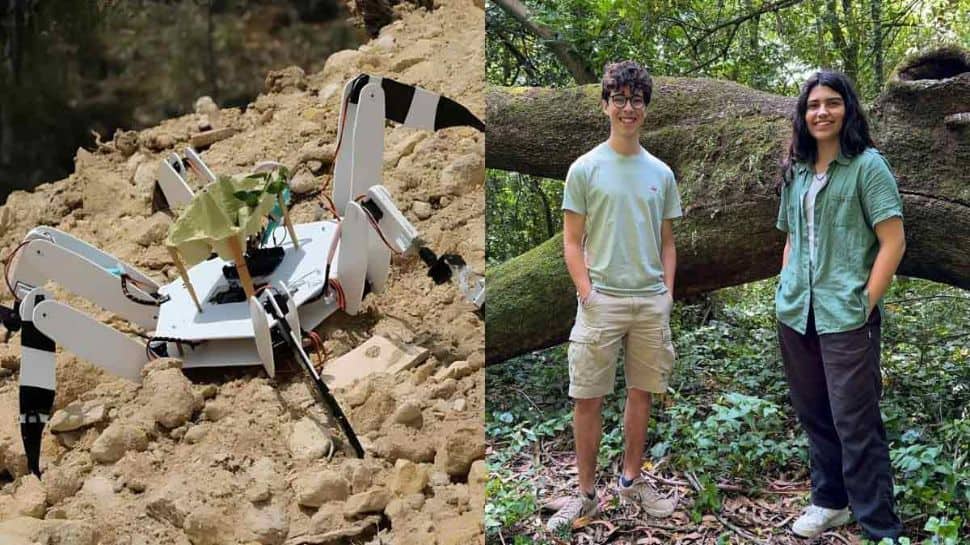
The recurring nightmare of wildfires transforming familiar hillsides into charred landscapes near Lisbon, Portugal, spurred teenagers Marta Bernardino and Sebastião Mendonça into action. Their deeply personal experiences with fire damage during their school years led them to pursue an ambitious technological solution. At just 19, they created Trovador, a novel six-legged robot designed specifically for reforestation in areas rendered inaccessible by fire and treacherous terrain.
Trovador, characterized by its spider-like movement, is engineered to navigate burnt and unstable ground, carrying saplings to sites where human replanting is perilous. This invention offers a vital new strategy for Portugal, a country frequently impacted by severe wildfires.
Portugal faces a persistent challenge with forest fires, with statistics showing over 1.2 million acres burned between 1980 and 2023. The year 2017 was particularly devastating, with wildfires causing the vast majority of tree cover loss. The steep and rugged nature of much of this affected land presents a significant hurdle for traditional reforestation methods, rendering many areas virtually unreachable for effective replanting.
Bernardino and Mendonça pinpointed the challenging terrain as the principal obstacle to effective recovery. Their analysis revealed that over 60 percent of Portugal’s forests are on steep slopes, where manual planting and the use of heavy machinery are either impossible or extremely hazardous. This makes keeping pace with the constant cycle of forest fires incredibly difficult.
The Trovador robot represents a revolutionary approach to this problem. Their first prototype, developed in 2023 with minimal funding and recycled components, demonstrated exceptional efficiency. It planted saplings 28 percent faster than human teams and achieved an impressive 90 percent survival rate without requiring follow-up care. Building on this success, they engineered a more robust version capable of operating on inclines up to 45 degrees.
“We build all-terrain robots that carry baby trees on their backs and plant them autonomously across difficult terrain,” Bernardino stated. The robot’s six-legged design ensures a light environmental impact by distributing weight evenly, thereby avoiding soil compaction that can impede root growth. A sophisticated system, including depth-sensing cameras and AI, guides Trovador. It navigates around obstacles and assesses crucial soil parameters like pH and moisture content before initiating its automated planting sequence, which is designed to ensure an 85-90 percent sapling survival rate.
Unlike drone-based reforestation efforts, which often involve scattering seeds with low precision and subsequent low survival rates, Trovador’s method focuses on planting individual, rooted saplings in optimal micro-locations. This precise approach maximizes resource efficiency and survival chances. The robot can plant up to 200 saplings each hour and transmits valuable data to the cloud for ongoing monitoring.
This innovative project has garnered significant international recognition, including a $10,000 grant from National Geographic and a major European sustainability award. Environmental specialists have praised the robot’s potential for reforestation in difficult-to-access areas but recommend further validation of its long-term performance, durability, and navigation capabilities. The creators plan to offer Trovador as a service to ensure affordability and accessibility for reforestation efforts. They aim to deploy Trovador for widespread landscape restoration by 2026, addressing the urgent global need for climate change mitigation.