

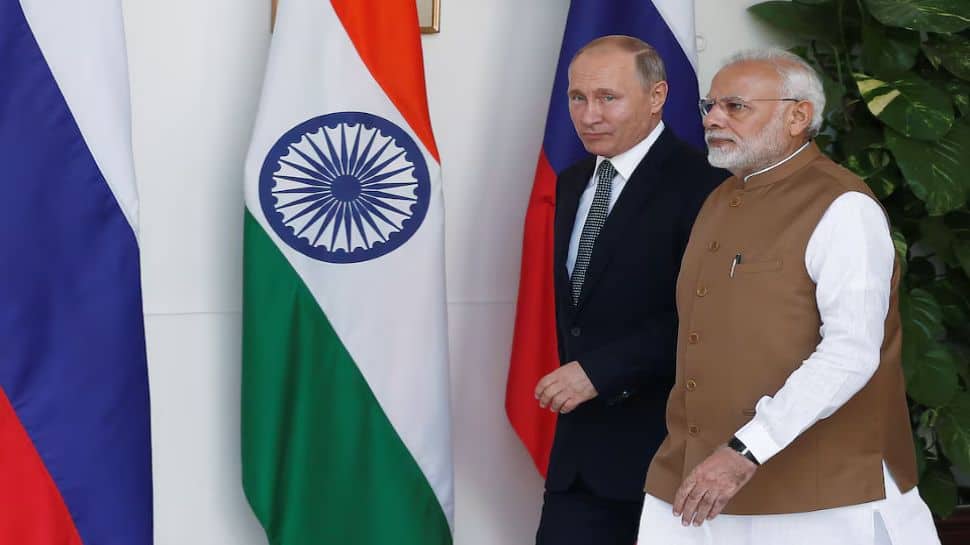
Operation Sindoor served as a striking example of India’s advanced battlefield capabilities, a feat significantly amplified by its robust and long-standing defense ties with Russia. This strategic partnership has been instrumental in equipping India with modern military hardware, including the formidable BrahMos supersonic missile, the state-of-the-art S-400 air defense system, and advanced fighter jets. The imminent visit of Russian President Vladimir Putin to New Delhi for high-level talks with Prime Minister Narendra Modi underscores the continued strategic importance of this relationship. Discussions are expected to include the progression of India’s indigenous ‘Indian Iron Dome’ initiative, the Sudarshan Chakra project, and potential further acquisitions of the S-400 surface-to-air missile systems, a platform that proved its mettle during recent military operations.
India’s defense collaboration with Russia has a deep historical lineage. By the 1970s, the Indian Air Force was already integrating Russian SAM-2 missiles into its arsenal. For decades, the MiG aircraft family and T-90 tanks have formed the bedrock of India’s defense preparedness. This relationship has evolved considerably, transitioning from a straightforward buyer-seller arrangement to a more sophisticated technology and joint development partnership. Over the last few decades, the focus has shifted from mere procurement to collaborative development of advanced systems, such as the highly effective BrahMos missile.
Named in honor of the Brahmaputra and Moscow rivers, the BrahMos missile system delivered outstanding precision during Operation Sindoor, showcasing its supersonic capabilities in accurately hitting targets in adversarial territory. The recently inducted S-400 air defense system from Russia also played a crucial role, effectively countering incoming missiles and drones. Its integrated radar and electronic warfare suites created a formidable shield, deterring enemy aircraft from entering Indian airspace. On the offensive front, Sukhoi fighter jets, manufactured domestically under Russian license, undertook critical strike missions, reinforcing their position as a key element of India’s air power.
The strategic cooperation between India and Russia extends beyond traditional military domains into critical sectors like nuclear energy, space exploration, and submarine development. Russian reactors are vital for India’s civilian nuclear program, joint space endeavors facilitate satellite launches and research, and ongoing submarine collaboration strengthens India’s naval capabilities. Currently, a significant number of Indian industries are collaborating with Russian firms on developing crucial defense technologies, thereby enhancing India’s strategic self-reliance. In a world marked by increasing uncertainties, India’s trust in Russia as a dependable strategic partner remains unwavering, reinforcing this as one of India’s most enduring and proven alliances. Operation Sindoor stands as a powerful testament to this enduring friendship, symbolizing how the Indo-Russian bond continuously fuels defense innovation and safeguards India’s security.