

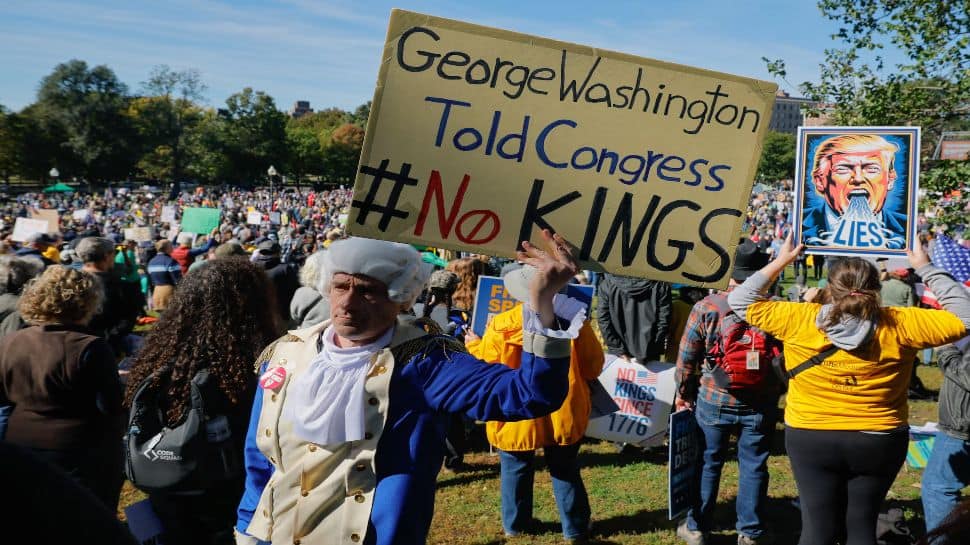
Millions of Americans marched in “No Kings” demonstrations across the country this weekend, protesting what they see as a dangerous authoritarian trajectory in the nation’s leadership. President Donald Trump’s response to the widespread protests was characterized by dismissal and mockery. His and Vice President JD Vance’s social media activity included images portraying Trump as a monarch, such as one depicting him piloting a “KING TRUMP” fighter jet over citizens and another showing Democratic leaders kneeling. These widely shared posts reinforced the administration’s focus on authority and control, while also drawing considerable criticism and debate.
Supporters of these images often framed them as lighthearted satire, dismissing critics as overly serious. However, many interpreted the visuals as a deliberate, subtle communication strategy aimed at positioning Trump as an untouchable, all-powerful figure—a potent appeal to voters who favor strong leadership. The President’s online behavior was widely viewed as contemptuous of tens of millions of Americans and a challenge to democratic ideals of free speech. While disdain for dissenting voters has been seen from previous leaders, the scale and audacity of Trump’s displays are considered by many to be unprecedented.
Analysts posit that recent liberal policies may have alienated some conservative voters, and the protests reflect a broader sense of unease within the populace. Critics argue that the president’s posts are part of a consistent pattern to assert his authority and diminish opposition, raising significant questions about constitutional limits and the nature of governance. Tensions heightened as the federal government approached a shutdown. President Trump dismissed the mass demonstrations as a “joke,” claiming the participants were unrepresentative of the American public and labeling them “whacked out.” He also suggested that reporters covering the protests were not accurately reflecting the nation’s sentiment.
In contrast, observers described the protests as peaceful and broadly supported, encompassing both progressive activists and moderate citizens who used satire and costumes to express their concerns about the administration’s policies. Trump’s actions extended beyond his digital presence. He commuted the sentence of former Representative George Santos, who had pleaded guilty to fraud. This move was widely perceived as a politically motivated use of presidential clemency, especially following Trump’s past calls for charges against political rivals. This fuels fears about the potential instrumentalization of legal power for personal or political ends and undermines the perception of impartial justice. Santos himself commented on the historical controversies surrounding presidential pardons, while his former colleagues highlighted the severity of his admitted crimes.
Furthermore, Trump authorized unilateral military actions abroad, including a strike against a suspected drug-trafficking boat in the Caribbean. The administration declared the traffickers terrorists and asserted the unilateral authority to strike without due process, circumventing Congress’s war powers. Critics warned that such actions risk eroding the rule of law and setting dangerous precedents, with Republican figures emphasizing the constitutional necessity of legislative approval for declarations of war.
Potential military action in Venezuela was also hinted at, with Trump warning foreign leaders about direct U.S. intervention if drug production issues were not resolved. Observers noted that this approach strains democratic norms and relies heavily on executive authority, often lacking transparency and oversight. The Defense Department under Trump also imposed strict press regulations and limited journalistic access, fueling concerns about reduced accountability.
These combined domestic and international actions suggest a growing concentration of power and an increasingly imperious approach to governance. The “No Kings” protests, involving millions of participants in over 2,700 events across all fifty states, signal a substantial public mobilization against perceived authoritarian trends. Organizers estimated seven million participants, a significant portion of the electorate. The movement brought together progressive activists and moderate citizens concerned about civic engagement. Demonstrators employed humor, costumes, and satire to voice their opposition to the administration’s rhetoric, underscoring their commitment to peaceful dissent and democracy. The fear of democracy being incrementally dismantled was a clear sentiment among retired government workers and participants, motivating some to travel to Washington to protest. The White House’s dismissive response to inquiries highlighted a significant disconnect from the deep concerns voiced by the public.