

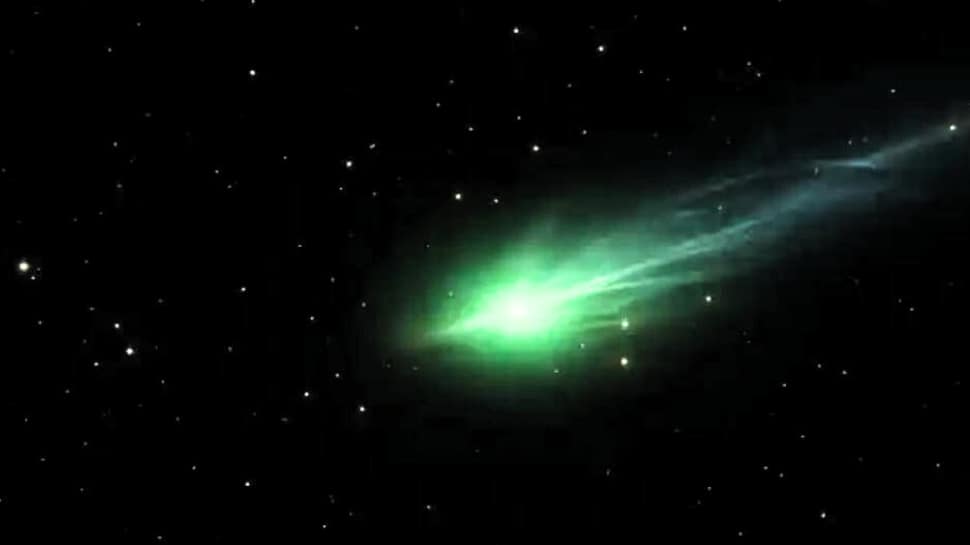
The interstellar comet 3I/ATLAS, first detected in July 2025, continues to baffle astronomers with its extraordinary resilience. Far from the expected brief appearance and subsequent disintegration, this comet has become a focal point of scientific mystery, characterized by its vivid blue-green glow and an expansive tail stretching over a million kilometers. Its most recent act of defiance was surviving a close solar pass in November, an event that typically proves destructive for cometary bodies.
Remarkably, 3I/ATLAS reappeared after its solar encounter in seemingly pristine condition. This unexpected survival has not only challenged astronomical models but also reignited speculation about its origins, with some suggesting it might be artificial. Avi Loeb, a Harvard astrophysicist renowned for his theories on extraterrestrial technology, has seized upon this event to bolster his claims.
New photographic evidence from the Nordic Optical Telescope, captured on November 11, indicates that 3I/ATLAS remains an intact, active object. Loeb highlights the exceptionally powerful jets of gas and dust emanating from the comet, arguing that their intensity is inconsistent with a natural nucleus of its size. He posits that the necessary absorptive surface area to generate such powerful outflows would need to be exceptionally large, exceeding 1,600 square kilometers, which he deems impossible for a natural comet.
Loeb’s calculations reveal a significant energy anomaly: the solar energy received by the comet at perihelion is insufficient to explain the observed mass-loss jets without a vastly larger absorbing surface. This discrepancy leads him to theorize that 3I/ATLAS might be an artificial object. He also points to unusual features like an anti-tail, which directs material towards the Sun, as further evidence.
In a bold proposition, Loeb suggests these jets could be ‘technological thrusters,’ a form of propulsion designed to increase the comet’s speed after its solar pass. This maneuver, he argues, could also explain why the object survived the intense solar radiation and heat.
However, mainstream scientific opinion remains skeptical. Darryl Seligman, a professor of astronomy, argues that the comet’s survival is entirely plausible for a natural object of its size, estimated at approximately 1 km in diameter. He believes Loeb’s estimates for mass loss and jet strength are overstated, and that 3I/ATLAS is behaving like a typical, robust comet.
Supporting the natural origin theory, radio observations from South Africa’s MeerKAT telescope detected hydroxyl radicals on October 24. This signature indicates that sunlight is breaking down water molecules—a classic sign of a comet actively shedding material as it heats up. This detection strongly suggests 3I/ATLAS is a water-rich comet expelling vapor as it nears the Sun.
The nature of 3I/ATLAS remains a captivating astronomical puzzle. Whether it proves to be a resilient natural phenomenon or a testament to extraterrestrial engineering, its journey through our solar system has profoundly impacted our understanding of cosmic objects.