

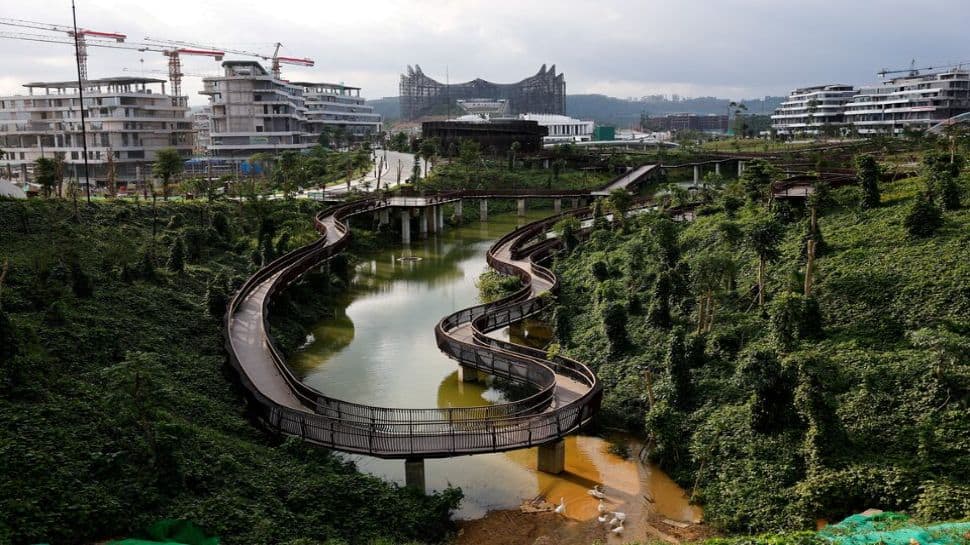
Indonesia’s ambitious project to construct a new capital city, Nusantara, in the Borneo rainforest is facing a dire threat: becoming a ghost town. Originally planned as a modern testament to progress and a solution to Jakarta’s overcrowding, the city is now marked by unfinished buildings and empty streets. The initiative, spearheaded by former President Joko Widodo, aimed to transition the capital to a new, greener location by 2030.
Currently, the expansive roads of Nusantara are predominantly empty, lined with partially constructed government facilities. The bustling activity expected in a new capital is absent, with only a few gardeners and sightseers present. The political leadership has shifted, and President Prabowo Subianto’s administration has drastically reduced financial support for Nusantara. The project’s budget saw a sharp decline from roughly 2 billion British pounds in 2024 to an estimated 700 million pounds for 2025. For the subsequent year, only 300 million pounds have been approved, representing just one-third of the requested funding. Private investment has also fallen significantly short, missing its goal by over 1 billion pounds.
Adding to the uncertainty, President Prabowo has not yet visited Nusantara since taking office. While he designated it as Indonesia’s ‘political capital’ in May, the announcement was delayed by four months. The leadership of the agency overseeing the project has also been unstable, with both the head and deputy head resigning in 2024, casting further doubt on the project’s trajectory. The current population of Nusantara comprises around 2,000 government employees and 8,000 construction workers, a stark contrast to the projected 1.2 million residents by 2030. Despite the presence of essential infrastructure like apartment blocks, ministry buildings, roads, hospitals, water systems, and an airport, much remains under construction. Experts warn that the project’s unclear future is a significant concern. Hardiansyah Hamzah, a constitutional law expert, has noted that the city already resembles a ‘ghost city.’ He further explained that the ‘political capital’ designation lacks legal grounding in Indonesia and signals that Nusantara is not a priority for President Prabowo. The grand vision for Indonesia’s new capital now teeters on the brink of abandonment.