

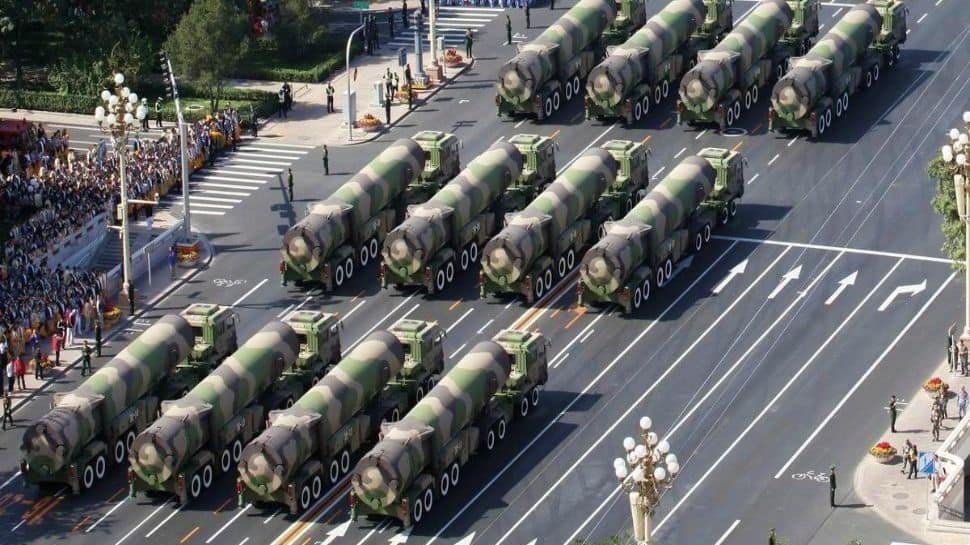
China has significantly bolstered its nuclear capabilities by deploying over 100 DF-31 intercontinental ballistic missiles (ICBMs) near its border with Mongolia, according to an unpublished Pentagon draft report. These missiles are housed in three newly constructed silo fields, underscoring Beijing’s commitment to enhancing its strategic deterrent. The DF-31 is a solid-fuel missile designed for rapid launch and effective evasion of most air defense systems.
The Pentagon had previously acknowledged the construction of these silo sites, but this recent assessment provides the first numerical estimate of the missiles deployed. China’s nuclear arsenal, which is estimated to possess around 600 warheads in 2024, is projected to grow to over 1,000 warheads by 2030. Beijing maintains that its nuclear strategy is guided by a “No First Use” policy, focused on maintaining a minimum level of deterrence.
The DF-31 missile, known internationally by its NATO designation CSS-10, is China’s third generation of mobile ICBMs. Introduced in 2006, it is a three-stage, solid-propellant missile capable of intercontinental reach. Its range varies, with the basic DF-31 covering 7,000 to 8,000 kilometers and the DF-31A and DF-31AG variants extending this to an impressive 11,000 to 11,700 kilometers, sufficient to strike targets across the continental United States. The missile’s physical dimensions are notable: approximately 13-15 meters in length, 2 meters in diameter, and a launch weight of around 42,000 kilograms.
Designed for swift deployment, its solid-fuel engine requires minimal preparation. The DF-31 is typically fitted with a single nuclear warhead, capable of a 1-megaton yield. Some advanced versions can carry Multiple Independently Targetable Reentry Vehicles (MIRVs), enabling a single missile to engage multiple targets simultaneously. Its inertial navigation system ensures accuracy within 100-300 meters. The missile can be launched from mobile transporter erector launchers or from the newly established fixed silos, offering enhanced operational flexibility and survivability.
The DF-31’s capabilities, including off-road mobility and penetration aids designed to circumvent missile defense systems, make it a significant strategic asset. Experts emphasize that silo deployment provides crucial protection against pre-emptive strikes, thereby increasing the resilience of China’s nuclear forces. The extensive reach of the DF-31 family poses a considerable strategic challenge to global stability, impacting major regions including the United States, Europe, and Asia. While international allies are closely observing these developments, China has yet to officially comment, prompting warnings from analysts regarding the potential ramifications for both regional and global security.