

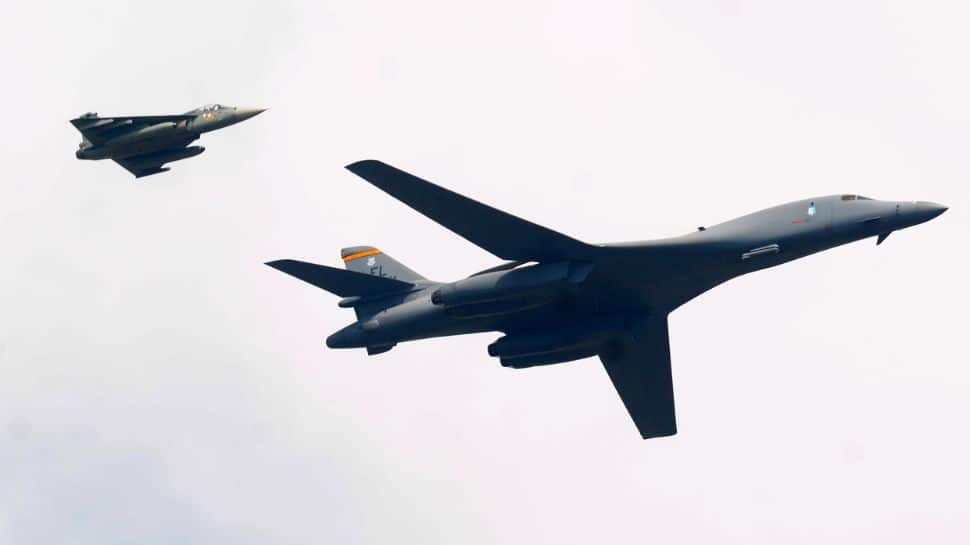
Forty years on, the B-1B Lancer bomber remains a cornerstone of American air superiority, a supersonic marvel nicknamed the ‘Flying Death Machine’ for its speed and lethal capabilities. It flies faster than sound and packs an immense punch, complementing the stealth capabilities of modern fighters with its vast payload and exceptional range. The bomber’s strategic significance is highlighted by its recent flights over the Caribbean and near Venezuelan airspace, part of ongoing efforts to combat drug trafficking and assert military presence.
The B-1B’s variable-sweep wing technology is a key element of its design, providing unparalleled versatility. This allows the aircraft to sweep its wings forward for improved lift during takeoff and landing, and retract them backward for reduced drag and enhanced supersonic performance. This dynamic capability is crucial for evading enemy air defense systems, allowing the bomber to operate effectively in contested airspace.
Under its fuselage are four powerful General Electric F101-GE-102 afterburning turbofan engines, capable of propelling the Lancer to speeds of Mach 1.2. Coupled with its extensive fuel tanks, this enables intercontinental reach, making it a potent tool for global power projection. The Lancer’s enduring effectiveness in service is a testament to its advanced design and the U.S. Air Force’s maintenance and operational expertise.
When operating at low altitudes, the B-1B becomes exceptionally difficult to detect. Its advanced sensor suite, including Doppler radar and synthetic aperture radar, allows it to navigate complex terrain while remaining virtually invisible to enemy radar. This low-level approach enables surprise attacks, with its weapons impacting before defensive measures can be activated. The capability to deploy advanced standoff munitions, including hypersonic missiles, means the Lancer can neutralize targets from distances far beyond the reach of enemy fighters and surface-to-air missile systems.