

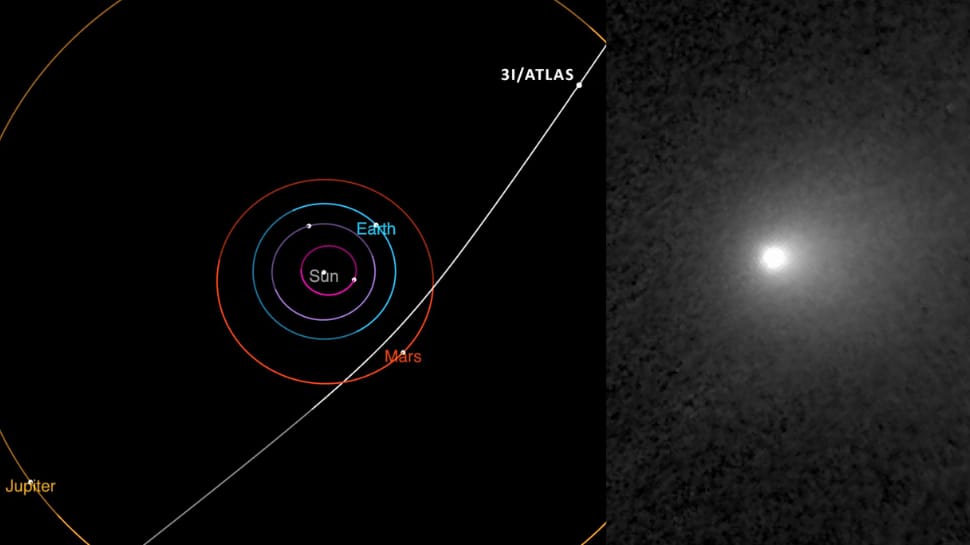
Since its announcement on July 1, 2025, interstellar comet 3I/ATLAS has become the subject of intense scientific debate. As the third known visitor from beyond our solar system, its unique characteristics have prompted some, including prominent Harvard astrophysicist Avi Loeb, to speculate that it might be evidence of alien technology rather than a purely natural celestial body.
One of the most puzzling aspects is its chemical composition. The comet is expelling roughly four grams of nickel per second, yet shows no signs of iron. This unusual elemental pairing, where nickel and iron are typically found together, challenges conventional explanations for its formation and suggests potential artificial engineering.
Further intensifying the speculation is the discovery of nickel tetracarbonyl, a chemical compound closely linked to industrial metal refinement on Earth. According to Loeb, this detection is a significant clue suggesting that the object may be composed of manufactured materials, aligning with the alien technology hypothesis.
The comet’s baffling anti-tail, which initially pointed towards the Sun, is another anomaly. Such behavior is almost unheard of in natural comets. Loeb suggests this unusual tail behavior could indicate controlled propulsion or maneuvering, features suggestive of an intelligent design.
Its trajectory is also a key factor. 3I/ATLAS travels on a hyperbolic path, meaning it is not gravitationally tethered to our Sun or any other star. This high-speed, unbound trajectory is characteristic of objects that might have been intentionally propelled or designed for long-distance interstellar travel.
Loeb and his team have also pointed out that 3I/ATLAS appears to have a smooth, reflective surface, lacking the expected rocky debris for an object of its size. This characteristic could indicate that it is constructed from refined metals, similar to man-made spacecraft.
At approximately 12 miles in diameter and traveling at speeds exceeding 130,000 mph, 3I/ATLAS is both exceptionally large and remarkably fast for an interstellar visitor. These extraordinary physical attributes invite questions about its origin and potential artificial nature.
The overall characteristics of the comet – its chemical makeup, emissions, and observed behavior – bear a striking resemblance to industrial-grade materials used in terrestrial metal processing. Loeb argues that these similarities are too pronounced to be mere coincidence, strongly suggesting the possibility of an alien-made artifact.
With 3I/ATLAS making its closest approach to the Sun between October 29-30, intensive observational campaigns by sophisticated spacecraft are underway. The data gathered from these observations could provide crucial insights into the comet’s true nature and its place within the cosmic landscape.