

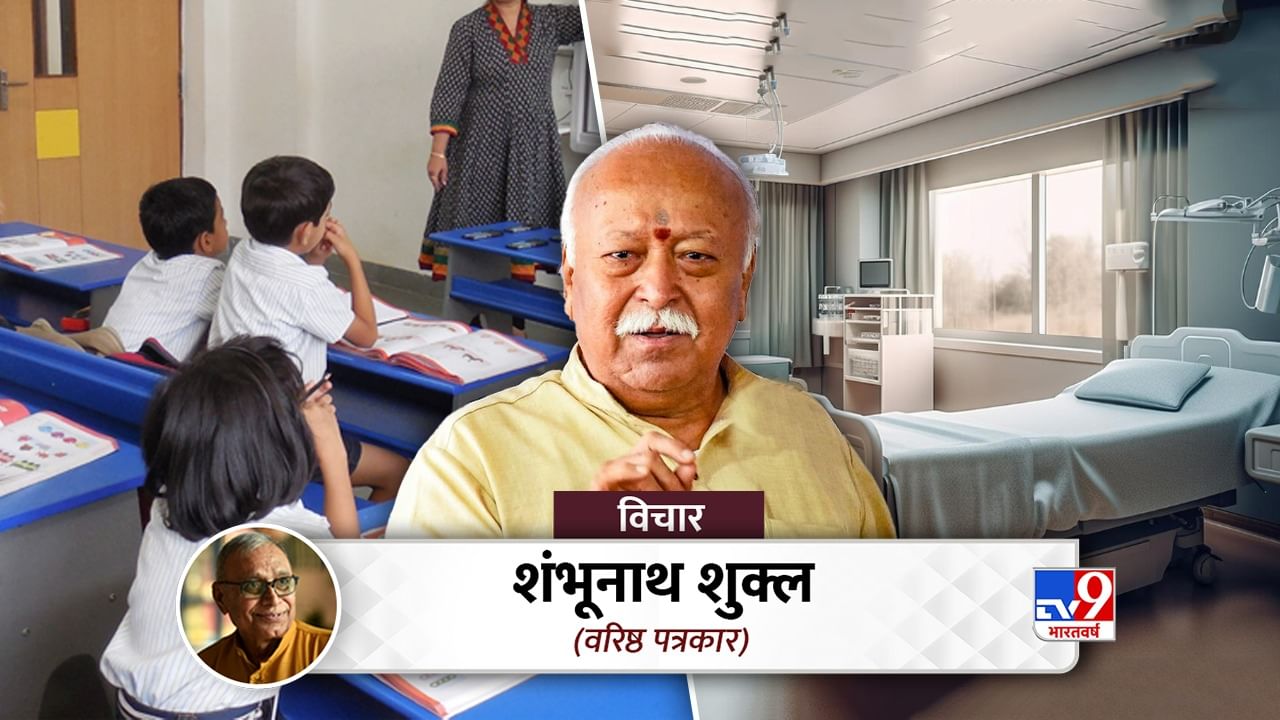
It’s often quipped that government teachers, despite their salaries, send their kids to private schools where teachers are paid far less. This reflects a troubling decline in the government’s educational focus, a stark contrast to the pre-independence era when national leaders didn’t rely on private education. Post-independence, the rise of private institutions led even government employees to choose them for their children.
A decade ago, on August 18, 2015, Allahabad High Court Justice Sudhir Agarwal proposed that all government employees, including politicians, should enroll their children in government schools, advocating for mandatory compliance. The then-Chief Minister ignored this suggestion. Justice Agarwal believed it would transform government schools. Had his advice been heeded, the current condition of government schools might have been avoided. The Uttar Pradesh Chief Minister now plans to close many primary schools, likely due to the influence of private institutions.
Without government schools, parents will inevitably opt for private education. While private schools may not always offer superior education, they often enforce stricter discipline and homework policies.
The healthcare situation is similar. Government hospitals, health centers, and community facilities exist, yet doctors and medicine are often unavailable. Patients are frequently sent to private hospitals, leading to excessive testing and financial burden. Although the government provides health cards like Ayushman, they often aren’t accepted by private hospitals. There’s no guarantee of quality care at private hospitals, potentially leaving patients worse off financially. Management in private hospitals often lacks compassion.
Where is the public welfare in this context? Governments prioritizing public well-being worldwide offer free healthcare. Despite potentially high taxes, citizens generally accept this if education and healthcare are free. Bhutan, our neighbor, offers free healthcare. Canada, the UK, France, Norway, Spain, Taiwan, and Cuba also provide it. Brazil even allows foreign nationals to receive free care in government hospitals. In the US, healthcare isn’t free; it’s expensive but can be of high quality, with the US leading in medical education.
RSS chief Mohan Bhagwat recently highlighted the poor state of education and healthcare, now driven by profit rather than service. He noted that while institutions exist, they’re often inaccessible to the general public. His concern is valid. Addressing this requires action, with the BJP currently in power.
The Congress has criticized the BJP based on Bhagwat’s statement, but the commercialization of these services is a trend across parties. Ashok Gehlot, former Rajasthan Chief Minister, implemented the Chiranjeevi Health Scheme, providing free treatment up to 25 lakh rupees to every resident, with EWS families exempt from premiums. Those not receiving pensions or eligible for government healthcare could access the scheme for 850 rupees annually. However, the scheme was discontinued after the change in government, and no similar programs have been replicated elsewhere.
Although education and healthcare are state subjects, the central government could implement nationwide programs, potentially through additional taxes, to standardize education. While private institutions should continue operating, the government must monitor them and restore government services. Immediate investigation of complaints is crucial. Recently, a judge from the Ghaziabad District Court passed away after hernia surgery at a private hospital. This highlights the need for strict oversight, especially considering potential negligence. In the US, hospitals face license revocation for negligence.
Where is the dream of Ram Rajya?
The commercialization of education and healthcare raises serious concerns, as highlighted by RSS chief Mohan Bhagwat. The vision of Ram Rajya, as envisioned by Mahatma Gandhi and based on accessible fundamental rights like education and healthcare, remains unfulfilled. According to Tulsi Das, Ram Rajya is a state free of sorrow, which often stems from lack of access to these services.