

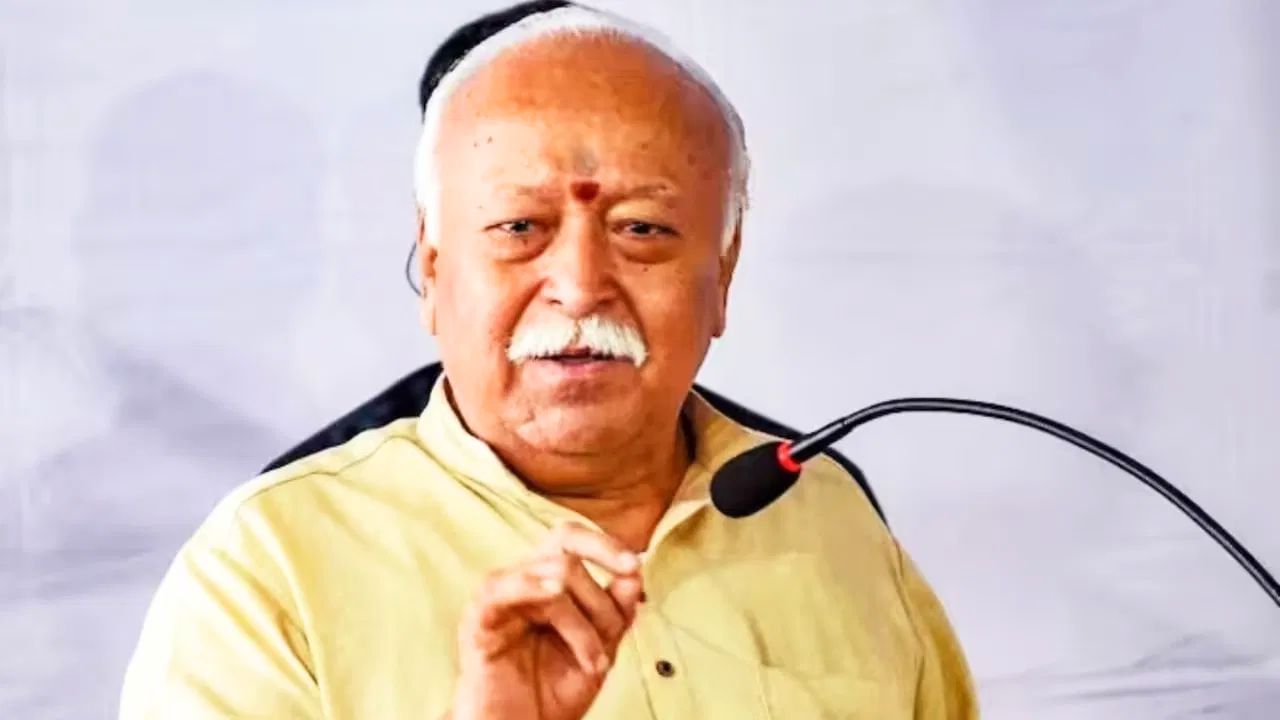
In a three-day lecture series marking the centenary of the Rashtriya Swayamsevak Sangh (RSS), RSS leader Dr. Mohan Bhagwat discussed the organization’s vision for India, emphasizing its role in positioning the nation as a global leader. He stated that the RSS’s core mission is inspired by the phrase ‘Bharat Mata Ki Jai’, central to their prayer, which highlights their dedication to India’s progress. He pointed out that the Sangh has been evolving over time, and its work continues.
Bhagwat clarified that while the RSS uses the term ‘Hindu,’ its philosophical foundation lies in ‘Vasudhaiva Kutumbakam,’ which views the world as one family. Within this concept, the Sangh integrates the village, society, and the nation. The Sangh is managed by volunteers who also train new members.
The lecture series, ‘100 Years of Sangh Journey – New Horizons,’ is being held at Delhi’s Vigyan Bhavan to provide accurate information about the Sangh to the public. Bhagwat noted that similar events were held in 2018, and this time, programs are being held at multiple locations to reach a wider audience.
He addressed India’s historical context, stating that a nation’s definition is not based on political power. He stated that India remained a nation even under foreign rule. The English word ‘nation’ is linked to the state, while the Indian concept is not tied to governance. Bhagwat discussed the freedom struggle and ideologies, noting the failure of the 1857 independence attempt, which sparked new awareness. This led to the need for Congress.
He mentioned the post-independence era, where one group focused on eliminating social evils, and the other wanted to return to India’s roots. He highlighted Swami Dayanand Saraswati and Swami Vivekananda’s contributions. Bhagwat discussed the views of Dr. Keshav Baliram Hedgewar, who believed that societal reform was essential, citing subjugation as evidence of societal flaws.
Explaining ‘Hindu,’ Bhagwat said it is not only religious but denotes responsibility to the nation. He clarified that while others gave the term, the Sangh views itself from an anthropological perspective, emphasizing the interconnection of humans and creation.
He stated that ‘Hindu’ is inclusive, without boundaries. He explained that Hindus embrace Indian values, traditions, respect others’ faith, and avoid insult or exclusion. The objective is to unify Hindu society. He emphasized that ‘Hindu’ is not about opposition, but unity.
Bhagwat said India is defined by harmony, not conflict. India’s unity comes from its geography, resources, and self-reflection. The goal is to look inward to find truth, which emphasizes shared essence within diverse forms. This vision led to reverence for Bharat Mata and ancestors.
He stated that those who identify as Hindu and those who identify as Indian or Sanatani share a common bond of devotion. India’s DNA connects everyone, emphasizing unity in diversity.
Bhagwat mentioned that those who previously distanced themselves from the term ‘Hindu’ are embracing it because quality of life improves, people reconnect with their roots. He reiterated the goal of building a complete Hindu society. When they say ‘Hindu Rashtra,’ they are not excluding anyone, and the RSS is not in opposition. He said that the Hindu Rashtra has nothing to do with power.
He explained the Sangh’s methodology, focusing on individual development and social work. The RSS builds individuals, and volunteers work in various fields without control. He acknowledged criticisms and neglect faced by the Sangh but highlighted its dedication to society.
Bhagwat concluded by emphasizing volunteers’ dedication. He underscored the importance of ‘Guru Dakshina’ to show volunteers’ commitment. He stated the importance of maintaining proper thoughts, values, and behavior. He also emphasized uniting everyone, rather than forming factions.
Also present were Dattatreya Hosabale, the Sangh’s General Secretary; Pawan Jindal, the Uttar Kshetra Sanghchalak; and Dr. Anil Agarwal, the Delhi Prant Sanghchalak. Attendees included retired judges, former diplomats, former administrative officers, diplomats, media heads, ex-army officers, and figures from sports and art.