

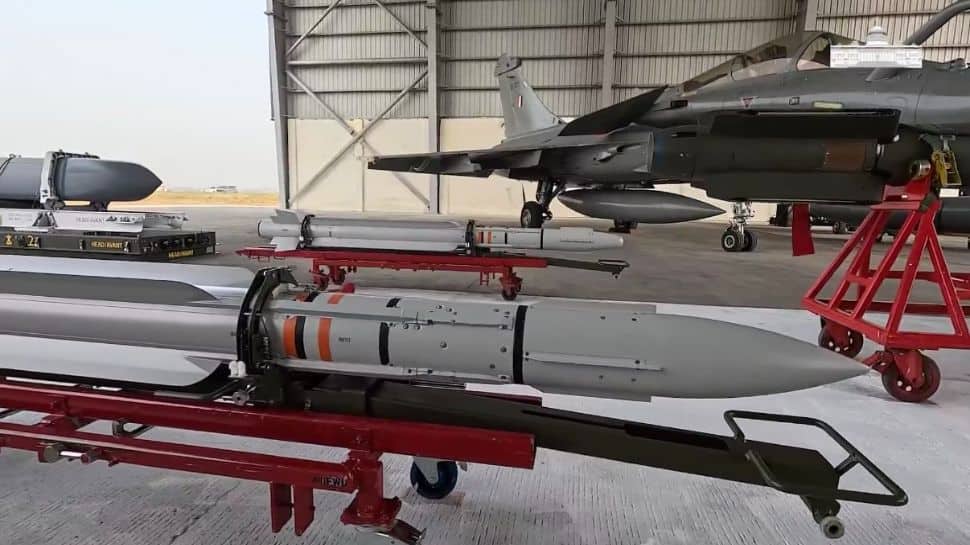
A decade after signing the landmark deal for French-made Rafale fighter jets, India is finally addressing a critical deficiency: the absence of the Meteor missile, widely considered the aircraft’s most potent weapon. The 2016 agreement for 36 Rafales, pitched as a decisive move to counter regional air threats, notably Pakistan’s F-16s, notably excluded this European-developed, long-range air-to-air missile. The Meteor’s ability to engage targets at extreme distances of nearly 200 kilometers is fundamental to the Rafale’s air superiority claims.
Now, in an effort to rectify this significant omission, the Ministry of Defence is reportedly close to approving a proposal valued at approximately Rs 1,500 crore for the procurement of a new batch of Meteor missiles. This move, aimed at enhancing the Indian Air Force’s (IAF) combat readiness, implicitly confirms that the Rafale fleet has been operating with a key capability gap for years. This belated acquisition highlights a substantial lapse in the initial planning and execution of the defence deal.
Defence experts and former military officials have strongly condemned the oversight, branding it a severe planning failure and a potential dereliction of duty. The justification for acquiring fewer, but more advanced, Rafale jets hinged on their superior capabilities, including the Meteor missile. Without this critical armament, the jets’ touted advantage over adversaries is significantly compromised. The decision to proceed with the acquisition without this defining weapon raises serious questions about the decision-making process and the accountability of those involved.
The strategic imperative for such long-range missiles was underscored during recent operational scenarios, where the ability to engage and neutralize enemy aircraft from a distance proved vital. The current push to acquire the Meteor missile is seen as a necessary step to finally realize the full operational potential of the Rafale fleet as envisioned a decade ago.
Alongside efforts to bolster indigenous missile development, such as the DRDO’s Astra Mark 2 program for other aircraft, the Rafale-Meteor saga brings into sharp focus the challenges in India’s defence procurement. The prolonged delay in equipping these advanced jets with their most crucial weapon raises uncomfortable questions about oversight, foresight, and the overall effectiveness of strategic planning within the defence establishment.