

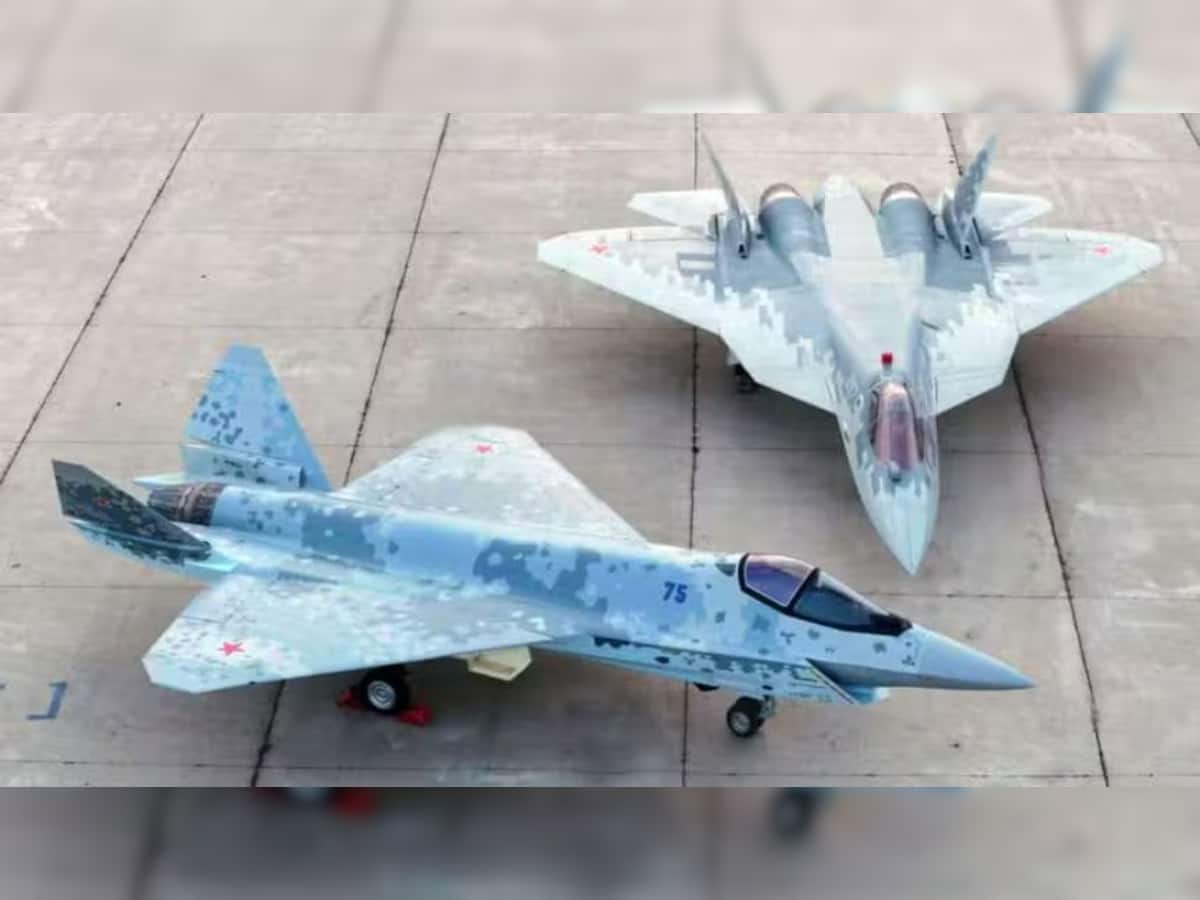
Russia has put forth an enticing offer to India, presenting two of its most advanced stealth fighter jets for consideration: the existing Su-57 and the under-development Su-75. This significant diplomatic maneuver coincides with President Vladimir Putin’s impending visit to India, underscoring the importance of defense ties. The Indian Air Force (IAF), facing a critical shortage of modern aerial combat platforms, is reportedly exploring these Russian options to address immediate capability gaps.
The Su-75 is being positioned by its manufacturers as the most cost-effective fifth-generation stealth fighter available globally, with an estimated price range of $30 million to $35 million. This single-engine aircraft is designed with a top speed of Mach 1.8, a significant operational range of 3,000 km, and can reach altitudes of up to 54,000 feet. Crucially, it features an internal weapons bay to maintain its stealth profile throughout missions.
A central aspect of Russia’s proposal is the commitment to facilitating local production in India. This would allow Hindustan Aeronautics Limited (HAL) to not only assemble these advanced fighters domestically but also to develop them as export products for burgeoning markets across Asia, Africa, and the Middle East. Moscow has also pledged to share advanced technological know-how, including expertise in stealth design, AI-integrated cockpit systems, advanced sensor fusion, and next-generation network-centric warfare capabilities – technologies that are often restricted by Western defense suppliers.
Hindustan Aeronautics Limited (HAL) has expressed a positive inclination towards joint development with Russia, although the specific fighter jet involved in such a collaboration is yet to be finalized. HAL executives have cited their comfort and prior success in working with Russian partners, referencing the assembly of aircraft like the MiG-21, MiG-27, and Su-30MKI. A joint venture could empower India with full intellectual property rights, significantly enhancing its self-reliance and providing a strategic advantage against potential import restrictions or geopolitical pressures.
Industry analysts believe that local manufacturing of the Su-75 could mirror the economic successes seen with the BrahMos missile program, potentially generating substantial export revenue without impacting the progress of indigenous projects like the Advanced Medium Combat Aircraft (AMCA). The Su-75, a lightweight single-engine stealth fighter, and the AMCA, a twin-engine medium-weight stealth aircraft, are designed to fulfill distinct operational roles. The cost-effective local production of the Su-75 offers a viable solution for meeting India’s immediate fighter needs.
Russia asserts that the Su-75 will offer unparalleled value for a fifth-generation fighter, featuring a supercruise-capable AL-41F1S engine, advanced avionics derived from the Su-57, and a fully internal weapons bay to ensure optimal stealth performance. The Su-57 itself is a proven fifth-generation multirole fighter, capable of engaging both air-to-air and air-to-ground targets. Its stealth characteristics, achieved through advanced materials and design, are key to its ability to operate undetected at long distances.
Analysts point out the Su-57’s specialized capabilities in Suppression and Destruction of Enemy Air Defenses (SEAD/DEAD) missions, which may exceed those of comparable aircraft like the F-35 or China’s J-20. This strategic advantage in neutralizing enemy air defenses makes the Su-57 a compelling option for the Indian Air Force. As India urgently seeks to modernize its air fleet, the choice between these Russian stealth fighters and continued engagement for Western aircraft, such as additional Rafale jets, represents a critical strategic decision for the future of the IAF.