

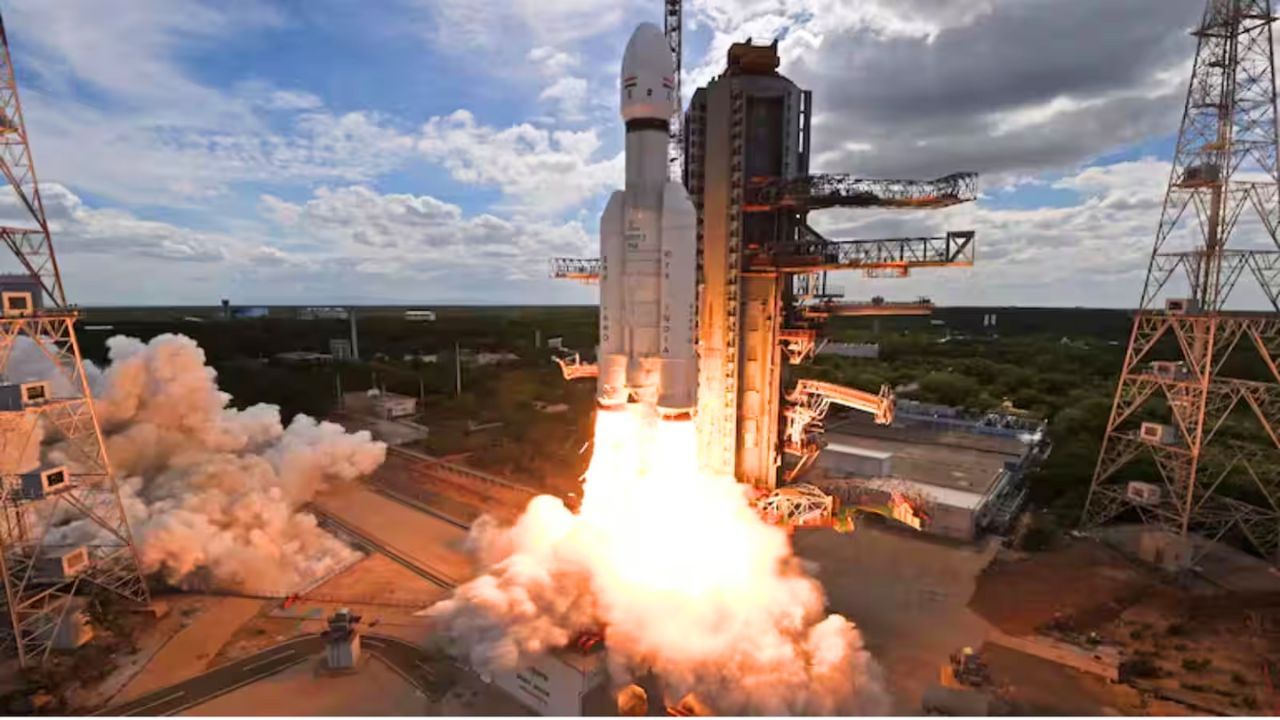
The Indian Space Research Organisation (ISRO) is planning to launch a 6,500-kilogram communications satellite manufactured by the United States in the coming months, as revealed by ISRO Chairman V. Narayanan. He made the announcement at an event. The launch will follow the successful launch of the NASA-ISRO Synthetic Aperture Radar (NISAR) mission on July 30, utilizing the GSLV-F16 rocket. This upcoming launch will see another US-made satellite placed in orbit.
During the 21st convocation at SRM Institute of Science and Technology in Kattan-kulathur, Narayanan was awarded an honorary Doctor of Science degree by the Governor of Maharashtra, C.P. Radhakrishnan. In his address, Narayanan reflected on the establishment of ISRO in 1963, when India was considerably behind other developed countries in space technology.
He noted that the Indian space program began with the donation of a small rocket from the United States in that same year. Narayanan added that in 1975, ISRO employed satellite data from the US to conduct public communication tests, setting up 2,400 television sets across 2,400 villages in six Indian states.
He pointed out that the launch of the NISAR satellite on July 30, 2025, represented a historic moment for the Indian space program, as the most expensive satellite to date. The L-band SAR payload was provided by the US and the S-band payload by ISRO. The satellite’s accurate placement into orbit by an Indian GSLV launcher emphasized India’s growing presence in space.
Narayanan acknowledged the praise from NASA for the precision of the GSLV-F16/NISAR mission’s launch. He emphasized the remarkable progress of a nation that started its space journey with a single donated rocket and is now poised to launch a large US-built communications satellite using its own launch vehicle in the coming months.
Narayanan also stated that, in contrast to its situation 50 years ago, ISRO has launched a total of 433 satellites for 34 different countries using its own launchers. He also mentioned ISRO’s contributions to Operation Sindoor, providing safety to Indian citizens through the use of satellites.
Referring to other key missions, Narayanan highlighted ISRO’s success in identifying water molecules on the moon’s surface during the Chandrayaan-1 mission and the Chandrayaan-3 mission’s soft landing on the south pole of the moon. Furthermore, he discussed India’s achievement of launching 104 satellites into the desired orbit using a single rocket, exceeding the previous record set by Russia.