

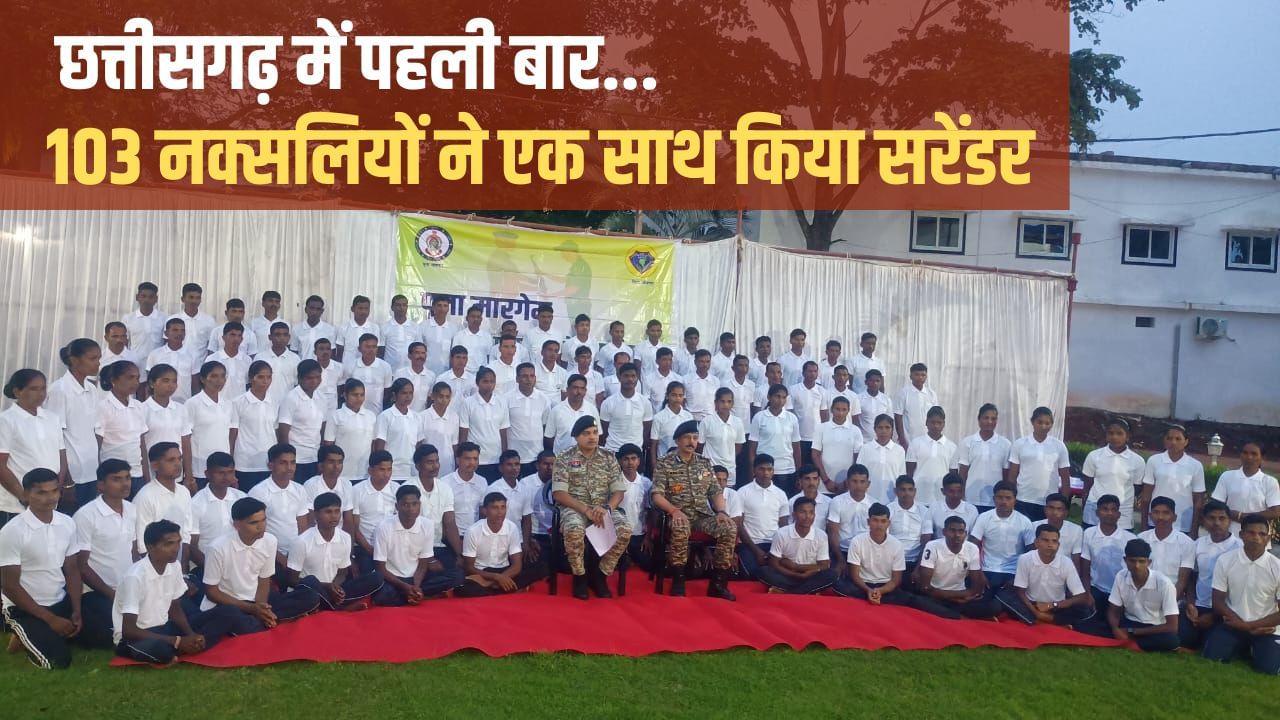
Bijapur district in Chhattisgarh witnessed an extraordinary event as 103 Naxalites surrendered to the authorities last Thursday. This significant act marks a first in the state’s history, representing the largest single surrender of Naxalites in a single instance. The police had previously announced rewards totaling 1 crore 6 lakh 30 thousand rupees for the capture of 49 of the surrendered individuals. Additionally, each Naxalite was given an immediate financial incentive of 50,000 rupees.
The surrender ceremony was attended by several high-ranking officials, including DIG (Dantewada Range) Kamlochan Kashyap, IG (CRPF Sector) BS Negi, and Bijapur SP Jitendra Kumar Yadav. Under the new surrender and rehabilitation policy implemented by the Chhattisgarh government, each surrendering Naxalite was provided a check for 50,000 rupees.
SP Yadav emphasized that the government’s policies are encouraging Maoists to reintegrate into the mainstream. He also highlighted the desire of the surrendered individuals’ families for them to lead normal lives, and appealed to other Naxalites to surrender and return to their families and society. According to the authorities, in Bijapur district alone, 410 Naxalites have surrendered this year, alongside 421 arrests and 137 Maoist fatalities.
The group of surrendering Naxalites included several high-ranking commanders. These included Lachhu Punem alias Santosh, the communication commander of the Southern Sub-Zonal Bureau; Guddu Farsa alias Vijay of Company No. 10; and Bhima Sodhi alias Kamal Singh/Sukhdev, who served as PPCM and security guard commander. Each of these commanders had a reward of eight lakh rupees for their capture. Also surrendering were area committee leaders, RPCs, militia commanders, and members of the Janatana Sarkar.
Based on police records, the majority of the Naxalites belong to the Muriya tribe and are aged between 18 and 40 years. They are primarily from rural areas within the Bhairamgarh, Gangalur, and Nelsonar police station jurisdictions.
The Chhattisgarh government has implemented a new Naxalite surrender and rehabilitation policy in 2025, aiming to eliminate Naxalism from the state by March 2026.
The government’s plan for the surrendered Naxalites includes financial assistance up to 5 lakh rupees for land and housing. An immediate incentive of 50,000 rupees is given to each individual. Special programs are also in place to support the education and employment of their children. Those with rewards of 5 lakh rupees or more are eligible for residential land in urban areas or agricultural land in rural areas, or property assistance worth 2 lakh rupees. Unmarried, widowed, or widower Naxalites are eligible for 1 lakh rupees in assistance for marriage, to be provided within three years. Law enforcement officers and other individuals who aid in surrenders are entitled to 10 percent of the declared reward amount, up to a maximum of 5 lakh rupees. In the case of collective surrenders from a single panchayat area, 4 crore rupees will be allocated for development projects in that area. Incentive amounts will be doubled for mass surrenders. Additional rewards are provided for the recovery of weapons and explosives.
The Bijapur police attribute the increasing frustration within the Maoist organization to factors such as leadership losses, internal disagreements, the impact of infrastructure development, and intensified actions by security forces. The central government has set a target to eradicate Naxalism from the country by 2026, leading to an intensification of counter-insurgency measures. The establishment of new security camps, road projects, and community policing initiatives have played a role in encouraging Naxalites to surrender. The joint efforts of the DRG, District Force, STF, and Cobra Battalion have also been instrumental.
The surrendered Naxalites were motivated by the Chhattisgarh government’s 2025 Surrender and Rehabilitation Policy and the Niyat Nellanar scheme. The government has communicated its commitment to offering respect and a new life to those who renounce violence and return to society. Those who surrendered received a 50,000-rupee incentive, with additional rewards for surrendering weapons, such as 15,000 rupees for an LMG and 10,000 rupees for an IED.
Authorities have stated that surrendered Naxalites are now contributing to the strength of the security forces. They have been integrated into the District Reserve Guard (DRG), and their local knowledge is proving invaluable.
Chief Minister Vishnudev Sai viewed the surrender as a victory for peace and development on Vijayadashami, stating that the 2025 Surrender and Rehabilitation Policy and the Niyat Nellanar scheme have instilled faith in the public. The surrender of 103 Naxalites in Bijapur is a testament to this, with the objective being to make Chhattisgarh completely Naxal-free by March 31, 2026.