

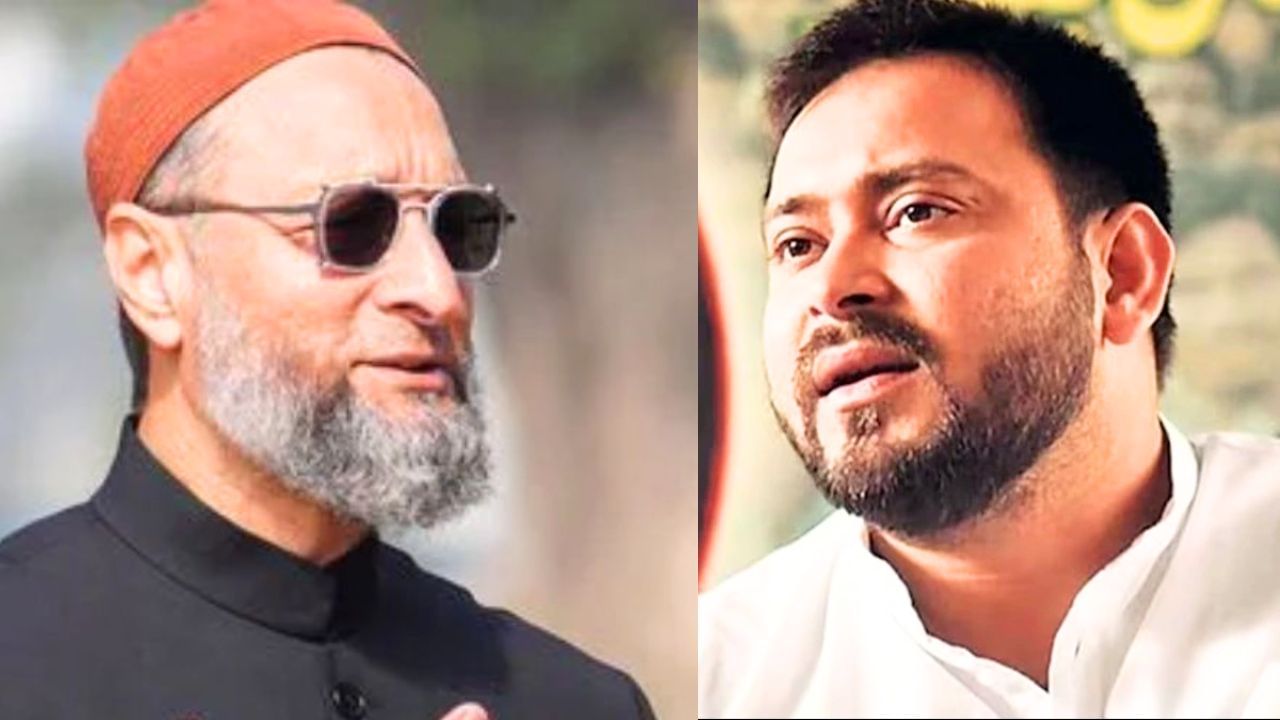
As Bihar heads towards assembly elections, political parties are actively engaged in formulating strategies and alliances. Key discussions are centered on seat-sharing arrangements. Amidst these developments, there are discussions regarding a potential alliance between Owaisi’s AIMIM, which secured five seats in the 2020 elections, and the Mahagathbandhan (Grand Alliance).
AIMIM representatives have expressed their willingness to partner with the Mahagathbandhan to prevent the BJP and its allies from returning to power. Akhtarul Imam, the AIMIM state president, took the initiative in this regard. However, RJD leader Tejashwi Yadav responded by stating that there had been no such discussions. Subsequently, Owaisi revealed that his party had proposed an alliance, but no response had been received.
Owaisi pointed out that a similar attempt was made in 2020, but it was unsuccessful. Subsequently, his party secured five seats. Akhtarul Imam then accused the RJD of poaching their MLAs, despite AIMIM’s support in the assembly.
He emphasized the importance of preventing the NDA from forming the government, leading to a proactive alliance offer. He also hinted at exploring the possibility of a Third Front, indicating ongoing communications.
The potential for a Third Front has triggered considerable speculation. It is believed AIMIM may replicate its 2020 strategy by forming a new alliance with smaller parties. In the 2020 election, Owaisi’s party formed the Grand Democratic Secular Front, encompassing Upendra Kushwaha’s RLSP, Mayawati’s BSP, Devendra Prasad Yadav’s SJD(D), Om Prakash Rajbhar’s Suheldev Bharatiya Samaj Party, and Sanjay Singh Chauhan’s Janvadi Party (Socialist).
Reports indicate that Akhtarul Imam is in contact with smaller parties. If AIMIM forms a Third Front, RJD and Congress could be significantly impacted.
RJD’s core support in Bihar’s politics comes from the M-Y (Muslim-Yadav) equation. Owaisi’s actions could directly affect the RJD-Congress alliance in Muslim-majority constituencies. Additionally, the entry of BSP could potentially threaten RJD in seats where Dalit and Muslim votes are critical. In the 2020 election, BSP won a single seat, with Mohammad Zama Khan securing the victory from Chainpur.
With AIMIM’s 5 seats added, RJD directly lost a total of 6 seats. Although most of the MLAs later changed parties, the election in Bihar’s Ramgarh seat witnessed a close outcome, with the current RJD MP Sudhakar Singh winning by a mere 189 votes against BSP candidate Ambika Singh. Currently, Upendra Kushwaha is aligned with the NDA, and Rajbhar is also with the NDA.
It is evident that both BSP and AIMIM plan to contest all seats separately. If they form another alliance, it could impact Congress’s Dalit outreach and the RJD-Congress’s Muslim voter base. Akash Anand, Mayawati’s nephew, is also actively campaigning for BSP in Bihar.
Owaisi also plans to extend his political reach by supporting Hindu candidates. He has already announced Rana Ranjit Singh as a candidate from the Dhaka seat. If AIMIM and RJD do not unite, Tejashwi Yadav could face challenges in several seats. Some believe that, considering how close RJD was to forming the government in the last election, Muslims may not want to take a similar risk again.
Tejashwi Yadav has been vocal on the Waqf issue for the Muslim community, which he presents as the strongest face in the opposition to defeat the NDA. There is a possibility that Muslim voters might reconsider their support. The future remains to be seen.