

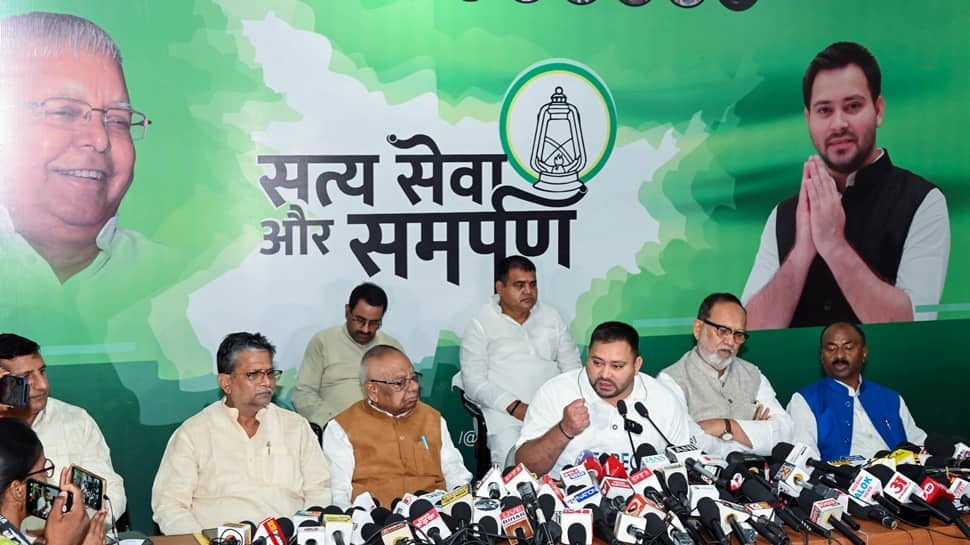
The political landscape of Bihar is being significantly shaped by a bold promise from RJD leader Tejashwi Yadav: one government job for every family lacking state employment, should his alliance win the upcoming assembly elections. This ambitious pledge, part of the ’20-20 formula’ (law in 20 days, jobs in 20 months), is being presented as a transformative solution to Bihar’s unemployment crisis and is a cornerstone of the Mahagathbandhan’s campaign.
The practical implications of this promise are being heavily debated. With 2.76 crore families in Bihar according to the latest survey, and about 18 lakh already having government employees, the scheme would target roughly 2.58 crore families. This implies a need for over 2.5 crore new government positions. However, available data indicates a shortfall, with only approximately 5 lakh government vacancies in Bihar. The fiscal burden is also a major concern. A monthly salary of Rs 25,000 for 2.58 crore individuals would lead to an annual expenditure of Rs 7.7 lakh crore on salaries alone. This astronomical figure is more than twice Bihar’s total state budget of Rs 3.17 lakh crore, prompting fears of severe economic distress.
Critics have voiced skepticism, labeling the promise as unrealistic. Nevertheless, the deep-seated aspiration for secure government jobs in Bihar, seen as a symbol of status and stability, cannot be underestimated. Political analysts suggest that Yadav’s pledge, despite its apparent economic challenges, could be a strategic masterstroke, resonating strongly with young voters and dominating the election conversation. The ruling party has also highlighted its own achievements in job creation. While the ‘one job per family’ promise has undoubtedly added significant momentum to the election campaign, its feasibility as an economic policy remains highly questionable, positioning it more as a powerful political gambit.