

In a significant advancement for exoplanet science, the James Webb Space Telescope has provided the most compelling evidence to date of an atmosphere surrounding a rocky world. This monumental discovery concerns TOI-561 b, an ultra-hot super-Earth approximately 275 light-years from our solar system.
TOI-561 b is characterized by its small size, about 1.4 times Earth’s radius, and its incredibly tight orbit around a Sun-like star, completing a full revolution in under 11 hours. This places it firmly in the category of ultra-short-period (USP) exoplanets, known for their extreme conditions.
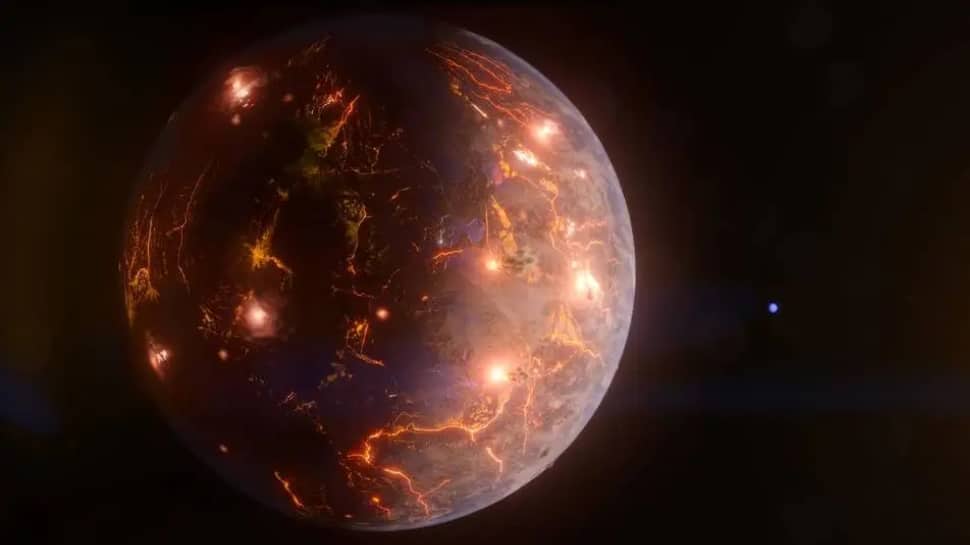
Analysis of data from Webb’s Near-Infrared Spectrometer (NIRSpec) suggests that TOI-561 b is a world of fire and gas. Scientists believe it is covered in a vast magma ocean, topped by a thick atmospheric layer. This challenges previous assumptions that rocky planets orbiting so close to their stars would be unable to retain any atmosphere due to intense stellar radiation.
A peculiar characteristic of TOI-561 b is its unexpectedly low density for a planet of its size. This observation could be explained by a depleted iron core and mantle, or, as this new evidence suggests, by the presence of a substantial atmosphere. The planet is thought to be rich in volatile elements, leading some researchers to describe it as a ‘wet lava ball.’
To confirm the atmospheric hypothesis, the team performed extensive observations over 37 hours, tracking the planet’s thermal radiation. Without an atmosphere to redistribute heat, the dayside temperature would reach an astonishing 2,700°C. However, Webb measured a considerably cooler dayside temperature of around 1,800°C.
This temperature differential is a strong indicator of atmospheric heat transport, suggesting that gases are circulating heat from the intensely illuminated dayside to the colder nightside. Researchers theorize that TOI-561 b may maintain its atmosphere through a unique process involving the release of gases from its molten surface and their subsequent reabsorption by the magma. This ongoing cycle could explain how such a planet survives in such an extreme stellar environment. These early results from Webb’s Cycle 2 mission have profound implications for understanding the diversity of rocky planets and the conditions under which they can host atmospheres.