

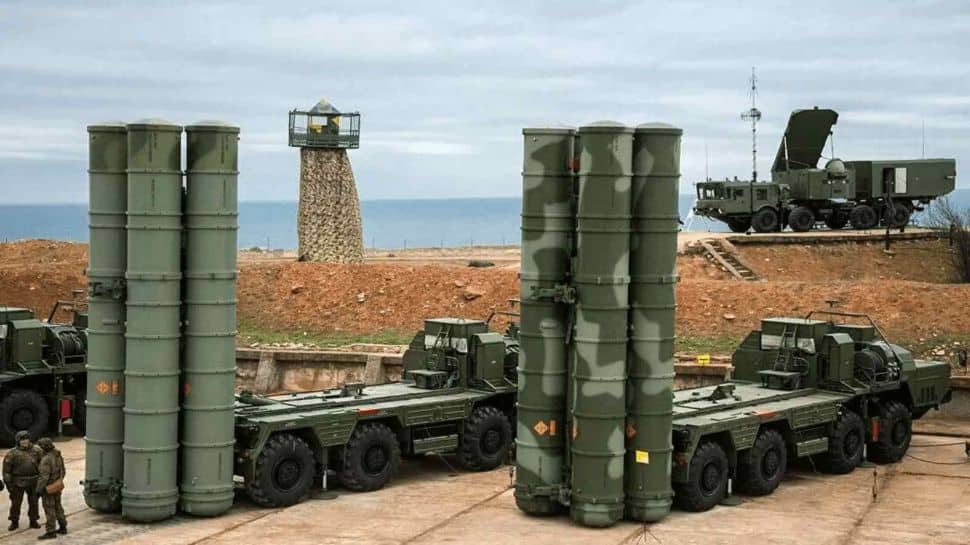
India’s defense planners are keenly assessing the potential acquisition of Russia’s S-500 missile system, a move that could dramatically enhance the nation’s air and missile defense capabilities. This advanced system is envisioned to work alongside the already deployed S-400, creating a formidable, multi-layered shield capable of countering the most sophisticated aerial threats.
The S-400 system has been a critical component of India’s defense strategy since 2018, effectively protecting its airspace against a range of threats including aircraft, cruise missiles, and select ballistic missiles. Its mobile and layered architecture ensures comprehensive coverage for vital assets. Experts acknowledge the S-400’s proven efficacy in providing robust regional air defense.
The S-500, also known as Prometheus, represents a significant upgrade, designed to confront emerging threats like hypersonic glide vehicles and advanced ballistic missiles that operate at higher speeds and altitudes. A key talking point surrounding the S-500 is its reported capability to engage targets in low-earth orbit, a frontier previously unaddressed by current air defense systems. This could offer India a strategic advantage in controlling near-space.
Publicly disclosed specifications suggest the S-500 can achieve engagement ranges of 500-600 kilometers and altitudes reaching tens to over a hundred kilometers for specific threats. This positions it as a powerful theatre anti-ballistic missile system with crucial counter-hypersonic capabilities, designed to complement the S-400’s operational reach. While the S-400 excels against conventional and tactical threats, the S-500 is geared towards strategic, high-speed, and high-altitude challenges.
Advancements in sensor and command and control technologies differentiate the S-500. It features next-generation radar systems with broader coverage and faster response times, enabling the rapid detection and tracking of multiple high-velocity targets. Furthermore, the S-500 employs ‘hit-to-kill’ interceptors, a necessary evolution for neutralizing hypersonic and ballistic threats that can survive proximity blasts, a capability beyond the primary design of the S-400’s interceptors.
While the S-400 is fully operational and integrated into India’s defense network, the S-500 is still in limited deployment within Russia. A potential transfer to India would be a strategically significant event, necessitating thorough political and logistical considerations. The integration of the S-500 would not replace the S-400 but would serve as an extension of its capabilities, creating an unparalleled air defense network that addresses threats from conventional aircraft to potential near-space incursions, thereby future-proofing India’s skies.