

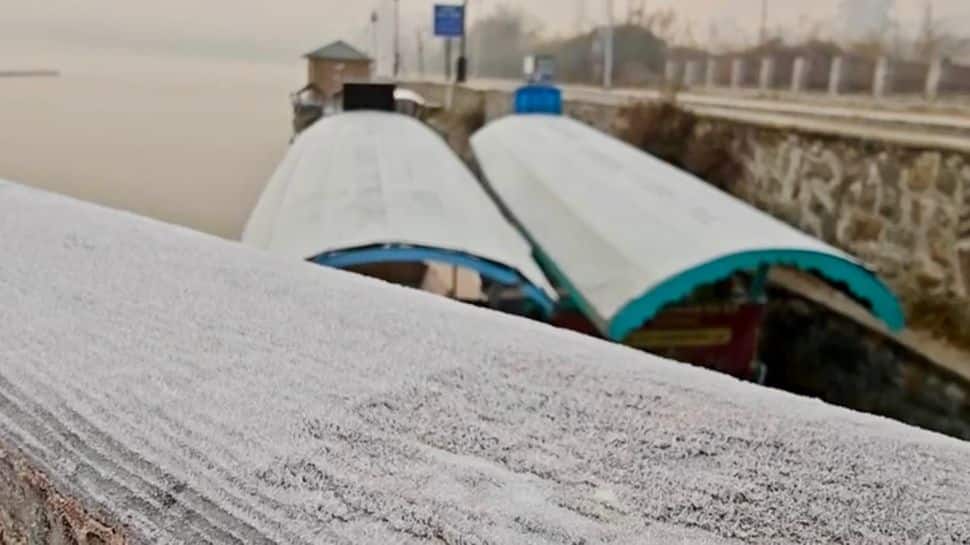
An intense cold wave is gripping Kashmir, with temperatures falling significantly below freezing across the valley. This severe chill is a direct result of a prolonged dry spell coupled with clear night skies, leading to substantial heat loss. The extreme weather has forced authorities to implement early winter vacations for schools, and health departments are urging residents to take precautions.
On Wednesday night, a fresh bout of intense cold descended upon Jammu & Kashmir and Ladakh, causing sharp overnight drops in temperature at nearly all locations. Within Kashmir, every monitoring station recorded sub-zero temperatures. Srinagar recorded -4.4°C, and Shopian experienced one of the coldest nights at -6.5°C. Pulwama and Baramulla followed at -5.8°C, Pampore at -5.5°C, and Anantnag at -5.7°C.
Srinagar Airport registered -5.2°C, and Pahalgam reached -5.0°C. Other areas also felt the severe cold: Budgam (-4.6°C), Bandipora (-4.5°C), Awantipora (-4.0°C), Sonamarg (-4.0°C), Ganderbal (-3.3°C), Qazigund (-4.0°C), and Kokernag (-1.6°C). Gulmarg remained slightly higher at -1.0°C, while Kulgam recorded -2.4°C.
In Ladakh, conditions were even more severe, with Leh at -8.6°C, Kargil -9.5°C, and Nubra -7.7°C. The coldest spot identified was Zojila Pass, which plunged to an extreme -16.0°C.
In contrast, the plains of the Jammu region maintained temperatures above freezing, with Jammu city at 8.7°C and Katra at 8.5°C. However, higher elevations in the Jammu region were considerably colder, including Banihal (-1.5°C) and Bhaderwah (0.4°C).
The sustained dry weather, lacking the insulating effect of snow and rain, has amplified the cold. Reports indicate the formation of icicles on trees and thick ice layers on roads and water bodies in the higher regions of Kashmir and Ladakh.
According to the IMD, these dry and cold conditions are expected to continue for the next week. A brief period of cloudy weather may occur around December 2-3, with a potential for rain and snow from December 6 to December 10, possibly bringing some relief. Kashmir is still anticipating ‘Chillai-Kalan’, the most severe 40-day winter period, which traditionally begins on December 21.