

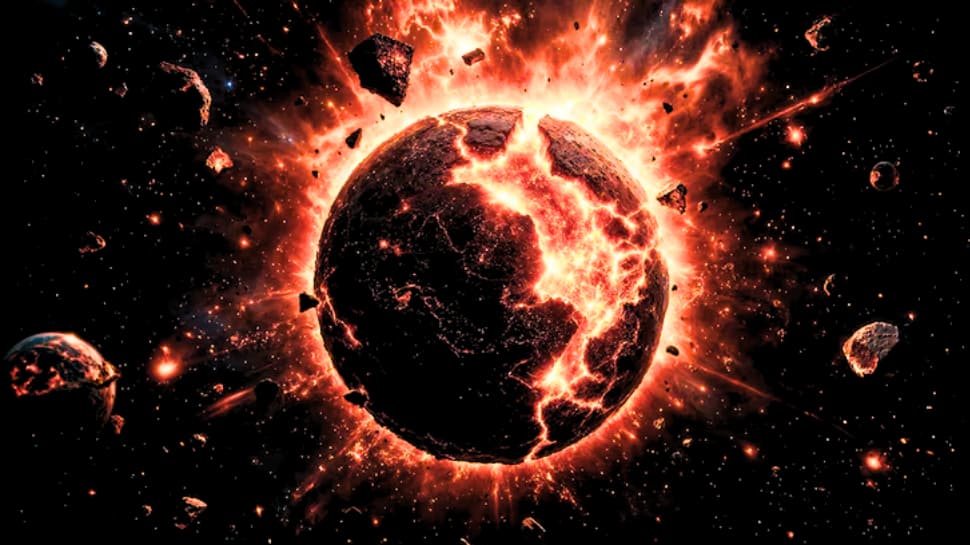
Forget the idea of a universe expanding into infinite coldness. A provocative new cosmological model suggests our universe has a definitive expiration date, marked by a dramatic ‘Big Crunch’ approximately 20 billion years from now. This radical departure from established theories comes from research led by Cornell University physicist S.-H. Henry Tye, proposing that the universe’s current expansion is not its final act.
The lynchpin of this new theory is a reinterpretation of dark energy. For years, cosmologists have operated under the assumption that dark energy is a constant, positive force propelling the universe outward at an accelerating rate. However, cutting-edge data from the Dark Energy Survey (DES) and the Dark Energy Spectroscopic Instrument (DESI) is challenging this notion. The findings suggest that dark energy might be dynamic, with its associated cosmological constant (Λ) potentially being negative. This shift would imply that dark energy could eventually reverse its effects, pulling the universe back together.
According to this model, cosmic expansion will cease in roughly 10 billion years. Over the subsequent 9 billion years, a powerful gravitational force, now dominant due to the change in dark energy, will accelerate the contraction of the universe. The ultimate endpoint is a Big Crunch, a singularity where all matter, energy, and spacetime collapse into an unimaginably dense point.
This intriguing scenario is further developed through a theoretical framework involving ultralight axions, hypothetical particles hypothesized to be fundamental constituents of both dark matter and dark energy. The model posits that the slow, gradual evolution of these axions over cosmic history could be responsible for altering dark energy’s behavior, transforming it from an expansive agent to a contractive one.
While speculative, the model’s strong alignment with data from extensive galactic surveys like DES and DESI lends it considerable weight. Researchers acknowledge the significant unknowns surrounding axions and dark energy, but the mathematical fit to observational data is compelling. The scientific community eagerly awaits results from future missions such as NASA’s SPHEREx, ESA’s Euclid, and the Vera C. Rubin Observatory. These next-generation instruments are expected to provide unprecedented precision in measuring dark energy’s properties, potentially confirming or disproving the prediction of a universe destined for a dramatic, finite end.