

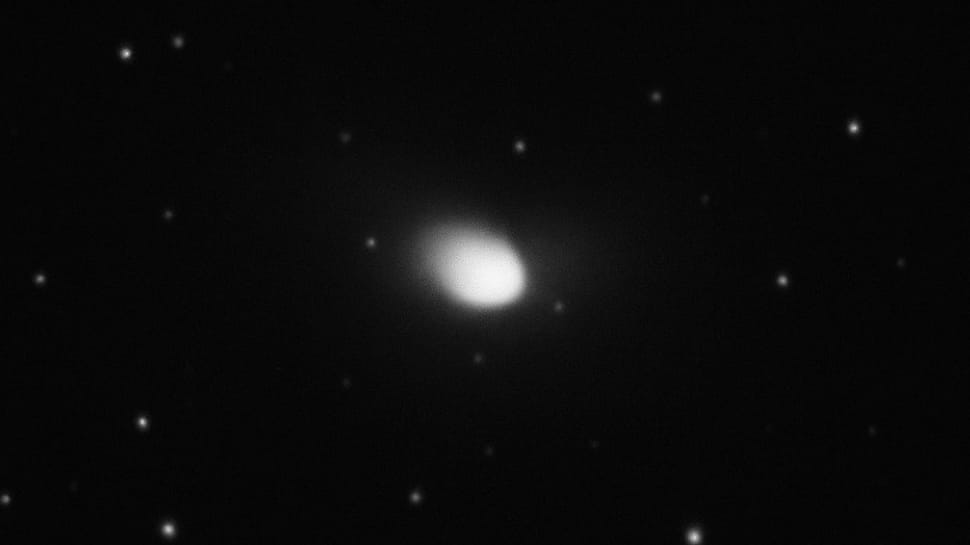
China’s Tianwen 1 mission has achieved another remarkable feat, capturing striking images of the interstellar comet 3I/ATLAS as it passed in the vicinity of Mars in early October. The China National Space Administration (CNSA) shared these stunning visuals, acquired between October 1st and 4th, offering an unprecedented look at an object originating from beyond our solar system. This event highlights the growing capabilities of China’s space exploration program.
Interstellar visitors are a rare phenomenon in astronomy, providing unique opportunities to study objects from distant star systems. 3I/ATLAS is only the third confirmed interstellar object detected, following ‘Oumuamua and 2I/Borisov. The comet’s passage near Mars triggered a significant global scientific response, with multiple space agencies, including NASA and ESA, dedicating instruments to its observation. Tianwen 1 joined this international effort, repurposing its High-Resolution Imaging Camera (HiRIC) from Mars surface imaging to track the fast-moving comet.
Successfully capturing images of 3I/ATLAS was a considerable technical challenge. The comet, measuring approximately 5.6 kilometers across, was traveling at an immense speed of about 58 km/s (129,800 mph). The Tianwen 1 team had to fine-tune the orbiter’s tracking systems and extend its imaging capabilities to acquire clear views. The processed images revealed essential details, including a solid nucleus and a diffuse coma, a vast halo of gas and dust surrounding the nucleus. This observation is a testament to the precision and adaptability of the Tianwen 1 mission.
The CNSA has framed this imaging campaign as a crucial technical experiment, expanding Tianwen 1’s role beyond planetary science to encompass interstellar object observation. The knowledge gained will directly influence the design and execution of future missions, such as Tianwen 2, which is planned for May 2025 to collect samples from a near-Earth asteroid. Tianwen 1, launched in 2020, has a proven track record, including its historic Mars orbit insertion in February 2021 and the deployment of the Zhurong rover. The orbiter continues its scientific operations, contributing valuable data and enhancing our understanding of the solar system and beyond.