

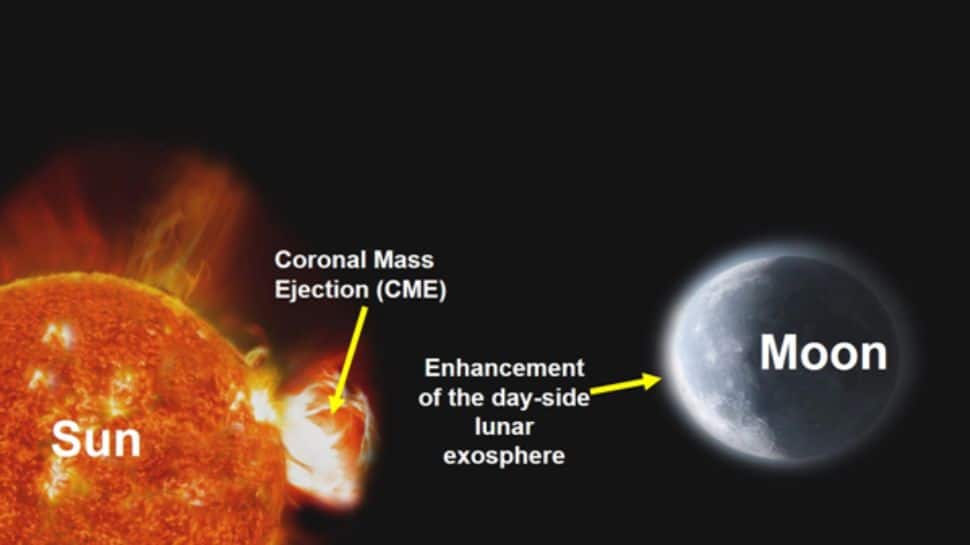
In a groundbreaking feat of space science, India’s Chandrayaan-2 orbiter has made history by capturing the first-ever direct observation of how solar Coronal Mass Ejections (CMEs) affect the Moon’s exosphere. This achievement by the Indian Space Research Organisation (ISRO) has captured the attention of the global space community.
The CHACE-2 instrument onboard Chandrayaan-2 detected a significant increase in the total pressure of the Moon’s day-side exosphere following a series of powerful CMEs that impacted the lunar surface on May 10, 2024. These CMEs, which are vast expulsions of solar material and magnetic fields, caused the density of neutral atoms and molecules in the Moon’s extremely thin atmosphere to rise by more than an order of magnitude. This observation provides the first empirical validation of theoretical models predicting such effects.
Scientists highlight that the Moon’s exosphere is a ‘surface-boundary exosphere,’ meaning it starts directly at the lunar surface and is highly reactive to solar wind and radiation due to the absence of a global magnetic field. The CME event energized the lunar surface, liberating more atoms and contributing to the enhanced exospheric pressure. This critical data gathered by Chandrayaan-2 will be indispensable for future lunar missions and the development of long-term human settlements. The research has been published in Geophysical Research Letters, underscoring India’s significant contributions to planetary science.