

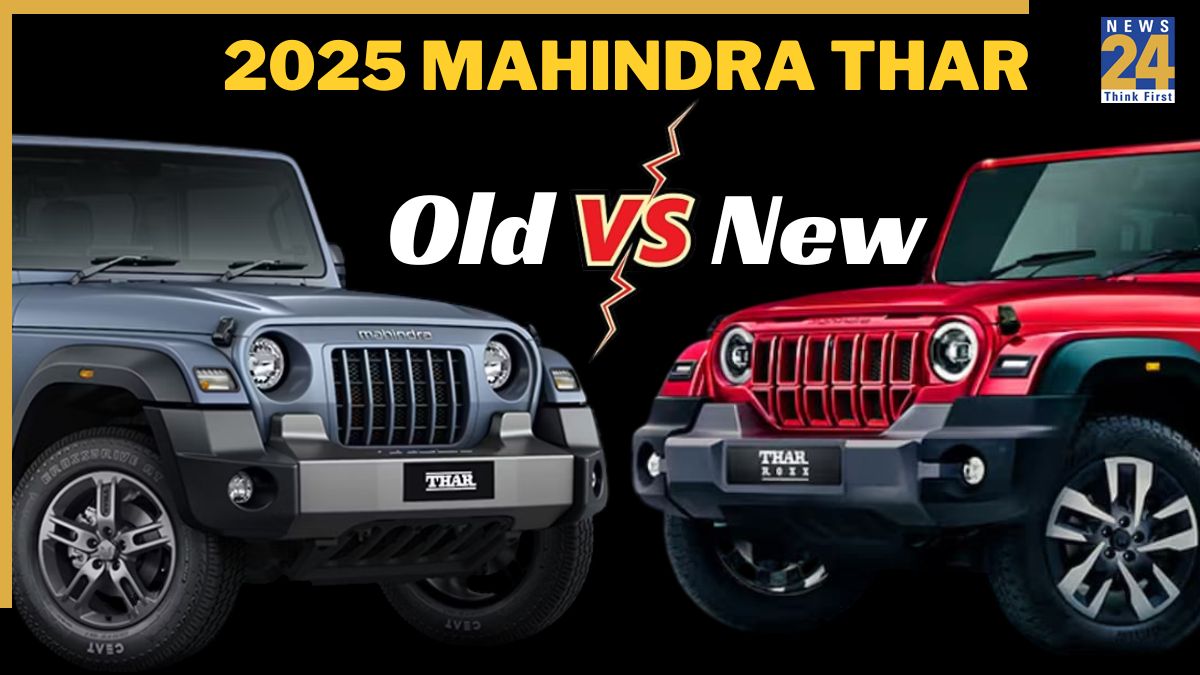
The 2025 Mahindra Thar facelift introduces a range of upgrades, including new features, cosmetic adjustments, and interior changes, while maintaining the original mechanical setup. This comparative analysis highlights the distinctions between the pre-facelift and the updated Mahindra Thar, covering design, interior, features, specifications, and pricing.
**Design: Evolution of the Thar’s Aesthetics**
The previous generation Thar was recognized for its rugged design, marked by elements like sturdy bumpers, detachable roof panels, squared wheel arches, the signature seven-slat grille, and other tough-looking details. The facelift preserves these core design aspects but refines them for a fresher appearance. The grille now comes in body color, creating a more seamless integration with the front. The redesigned dual-tone bumpers, featuring silver accents, provide visual contrast. Furthermore, Mahindra has introduced two new color options: Battleship Grey and Tango Red, with Tango Red replacing the old Rage Red.
**Feature Enhancements: What’s New in the 2025 Thar?**
The older model included amenities like steering-mounted controls, manual AC, roof-mounted speakers, and a 7-inch touchscreen.
The 2025 Mahindra Thar facelift brings several improvements, such as an electric fuel-lid opener, Type-C charging ports for front and rear occupants, and rear AC vents. The infotainment system has been upgraded to a larger 10.25-inch display and incorporates a redesigned interface compatible with Android Auto and Apple CarPlay. Additionally, the new Thar features a reversing camera, as well as a rear wiper and washer.
**Interior Upgrades: A Detailed Look**
The original Thar’s interior was engineered to withstand both daily driving and demanding off-road conditions, making it a practical choice. It offered features such as roof-mounted speakers, a touchscreen infotainment system, and washable floor panels. Despite its straightforward layout, it provided the comfort one expects from a modern SUV, while also being rugged enough for challenging terrains.
Mahindra has implemented interior upgrades, including a redesigned steering wheel. The facelift version now incorporates grab handles on the A-pillars with ‘THAR’ branding for the driver and front passenger – previously, this feature was only on the co-driver’s side. A sliding armrest with storage has also been introduced. Automatic variants now include a dead pedal. Moreover, the power window switches have been relocated to the door armrests from the center console.
**Powertrain: Familiar Engines Remain**
The facelifted Thar retains its existing engine options. It continues with the 1.5-liter diesel engine producing 118PS/300Nm, a 2.2-liter diesel delivering 132PS/300Nm, and a 2.0-liter turbo petrol making 150PS/320Nm. Available transmission choices include a 6-speed manual and a 6-speed torque converter automatic.
The rear-wheel drive configuration is paired with the 1.5-liter diesel (manual only) and the 2.0-liter turbo-petrol (automatic only). The four-wheel drive setup is available with the larger diesel engine and the turbo-petrol, both offered with manual and automatic gearboxes.
**Price, Rivals, and Market Positioning**
The earlier model was priced between Rs 11.35 lakh and Rs 17.60 lakh (ex-showroom). The 2025 Mahindra Thar facelift is priced between Rs 9.99 lakh and Rs 16.99 lakh (ex-showroom). Both models remain direct competitors to vehicles like the Force and Maruti Jimny.