

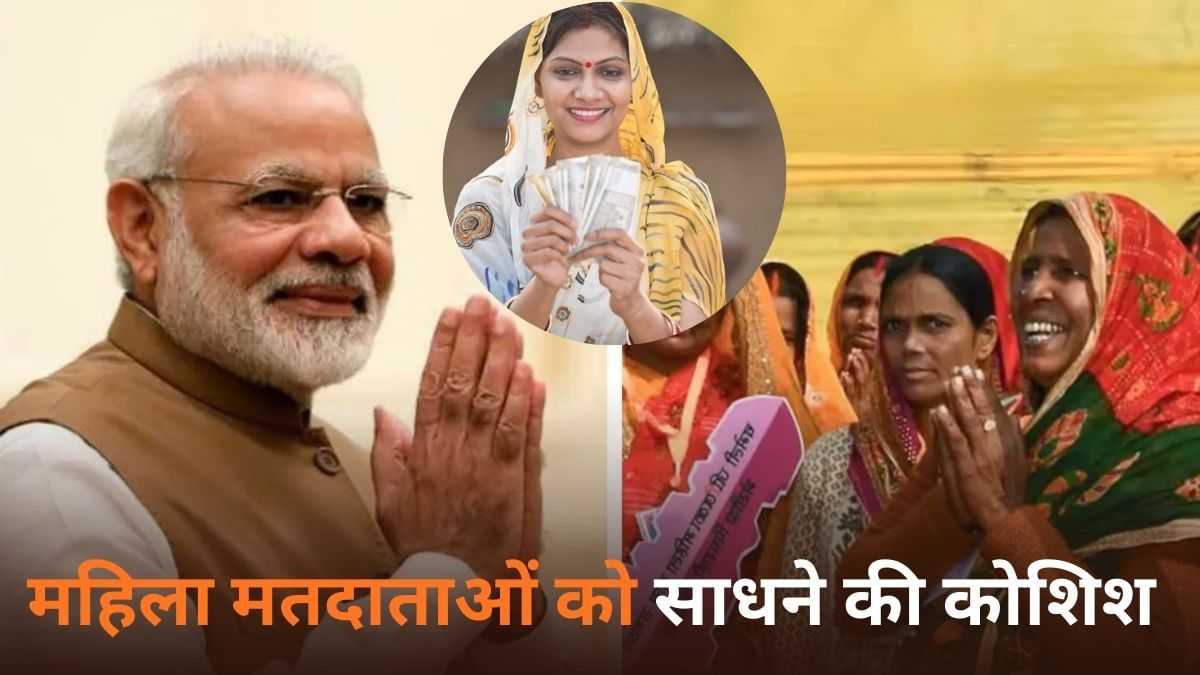
The role of female voters has become increasingly pivotal in election dynamics. In response, governments across India are implementing various schemes designed to appeal to women. This approach, which prioritizes women, involves directly delivering initiatives from both central and state governments to women in their homes.
In a recent development, Prime Minister Narendra Modi unveiled a significant program for the women of Bihar. Under the Mukhyamantri Mahila Rozgar Yojana, the PM transferred an initial installment of ₹10,000 each to 7.5 million rural women. This scheme aims to provide financial assistance of up to ₹2 lakh per woman. This move is considered a substantial effort to connect with women voters directly before the upcoming elections.
History demonstrates that political parties across different states have consistently made attractive promises to attract women during elections. These promises have often yielded direct benefits for the parties. For instance, in Bihar, Nitish Kumar, and at the national level, the Modi government, have successfully won elections by focusing on women-centric schemes. This approach has led to its adoption by other political parties, which have also seen positive results. With PM Modi’s recent announcement in Bihar, it’s evident that the 2025 electoral campaign will likely center on issues of importance to women.
In Andhra Pradesh, Jagan Mohan Reddy’s government provided smartphones to every member of women’s self-help groups. Furthermore, free sanitary napkins were distributed to adolescent girls in government schools. The Jagananna Ammavodi scheme provided ₹15,000 to mothers who send their children to school. Brides from the OBC community received ₹50,000, while SC/ST and minority brides received ₹1 lakh as marriage gifts.
Similarly, in Maharashtra, the BJP government runs the Ladki Bahin Yojana, initiated by Chief Minister Eknath Shinde. This scheme directly benefited the BJP-Shiv Sena alliance in the previous assembly elections. The scheme continues under the Fadnavis government. In Haryana, the BJP government is implementing the Deen Dayal Lado Lakshmi Yojana, which promises to give every woman ₹21 per month.
In West Bengal, the Mamata Banerjee government is implementing the Rupashree Yojana to attract women, offering ₹2.5 lakh to economically disadvantaged families for their daughters’ marriages. In addition, the Kanyashree Yojana provides annual scholarships to school girls aged 13-18 years.
Telangana’s government, led by K. Chandrasekhar Rao, has launched schemes like Shaadi Mubarak and Kalyana Lakshmi, providing ₹1 lakh to brides’ families. The KCR Kit scheme offers ₹13,000 for essential items for newborns and mothers. In Tamil Nadu, the marriage assistance scheme gives brides an 8-gram Jayalalitha gold coin. In Karnataka, the Saptapadi Vivah Yojana provides brides with a Mangalsutra worth ₹40,000, ₹10,000 in cash, and grooms with ₹5,000 in cash.
In Uttar Pradesh, the Yogi government’s Shaadi Anudan Yojana provides ₹55,000 for the marriage of two daughters of a labor family and ₹61,000 for inter-caste marriages. The Bhagyalakshmi Yojana offers bonds of ₹50,000 for the education of daughters from poor families. In Assam, the Arundhati Yojana provides brides with one tola of gold, while the Gyan Deepka Yojana waives admission fees, provides free school uniforms, and offers e-bikes. The Indira Miri Universal Widow Pension Yojana provides immediate assistance of ₹25,000 to widows over 45 years of age.
The Chhattisgarh government offers financial aid to widows and divorced women through the Shakti Swaroopa Yojana. The Mahtari Vandan Yojana was implemented by the BJP government, and the announcement of this scheme prior to the elections benefited the BJP. In Odisha, during Naveen Patnaik’s tenure, women from self-help groups received smartphones. The Mamata Yojana provides ₹5,000 to pregnant women for maternal and infant care, and the Subhadra Yojana provides additional support to women.
In Rajasthan, the Ashok Gehlot government’s Devnarayan School Scooty Yojana provided scooters to 6,000 meritorious tribal girls, along with free education in government institutions. The Aapki Beti Yojana provides ₹1,000 to girls in classes 1-8 and scholarships of ₹2,100 to students in classes 9-12. In Delhi, the BJP government has promised ₹2500 monthly to poor women under the Mahila Samriddhi Yojana.
During the Kamal Nath government in Madhya Pradesh, the Mukhyamantri Kanya Vivah/Nikah Yojana provided ₹51,000 to brides. The Ladli Behna Yojana, which was launched during the Shivraj Singh Chouhan government, remains in effect. This scheme is believed to have significantly boosted the popularity of Shivraj Singh Chouhan.
From Nitish Kumar’s cycle scheme in Bihar to the Modi government’s Ujjwala Yojana and the Delhi government’s free bus travel, female voters have consistently proved to be a decisive factor. This has led to state governments introducing various schemes designed to assist women, including cash transfers, smartphones, gold, scooters, education support, pensions, and employment initiatives.