

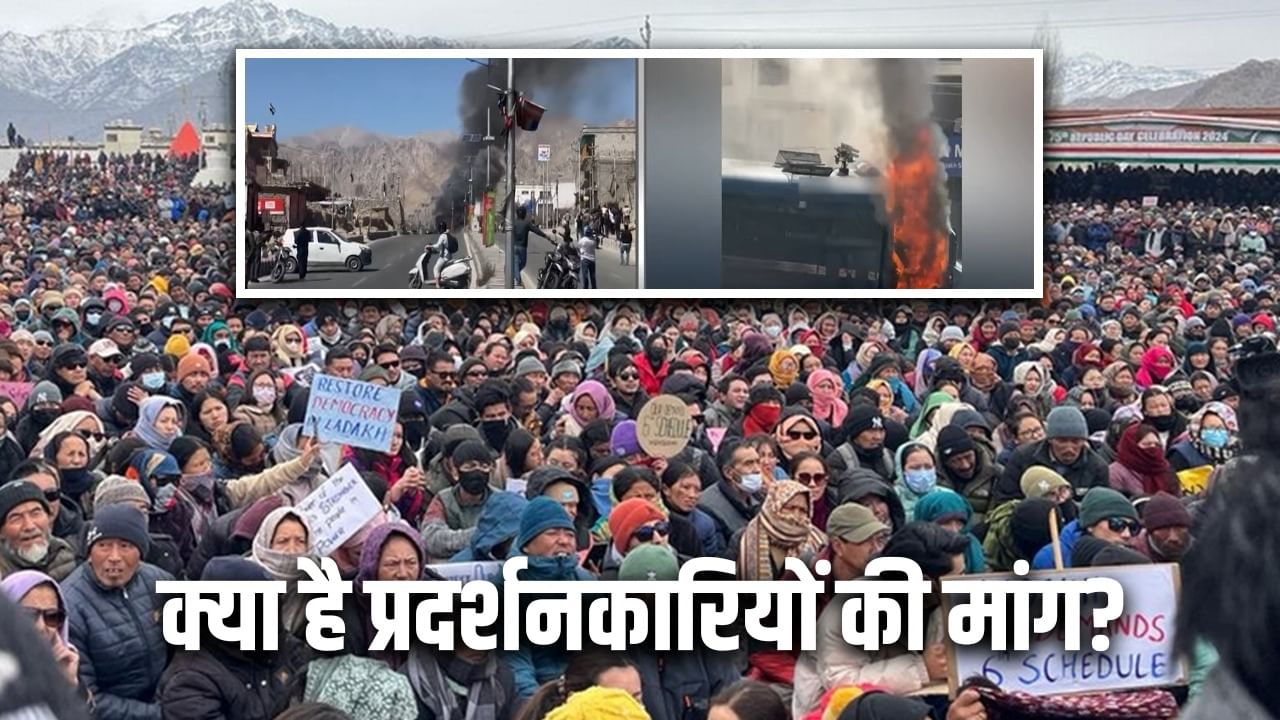
Protests in Leh, Ladakh, are escalating, with the primary demands being full statehood and inclusion in the Sixth Schedule of the Constitution. The protests, led by climate activist Sonam Wangchuk and occurring for the last fifteen days, turned violent on Wednesday. Clashes between students and police led to the burning of a CRPF vehicle and the BJP office. The protesters are voicing their discontent with the central government and want their demands met promptly.
Before August 5, 2019, Ladakh was part of Jammu and Kashmir. It was later reorganized into a Union Territory. Now, the residents of Ladakh want inclusion in the Sixth Schedule, which provides autonomy. Let’s examine what the Sixth Schedule is and why it’s important to the people of Ladakh.
Initially, the people of Ladakh were pleased with the central government’s decision, expecting rapid development as a Union Territory. However, their hopes diminished as they became increasingly reliant on the central government for almost everything, using the Lieutenant Governor and a Member of Parliament as their means of communication. This led to a rising sense of unity and the start of protests to assert their rights.
Inclusion in the Sixth Schedule would grant Ladakh a form of autonomy. Articles 244(2) and 275(1) of the Constitution provide these specific provisions. Ladakh had these rights when it was part of Jammu and Kashmir.
This special arrangement is in place in the northeastern states of Assam, Tripura, Meghalaya, and Mizoram. Implementation enables the formation of autonomous districts for effective governance. Each district typically has 30 members, with a portion nominated by the Governor and the remainder elected by local people. Major decisions within these districts require district panchayat approval. This requires the central government to provide these rights under the Constitution.
As a Union Territory, Ladakh no longer has elected MLAs. Formerly, four MLAs represented Ladakh in the Jammu and Kashmir Assembly. This lack of representation is a major reason for public anger. They claim they lack an effective way to communicate their concerns to the government. They feel the government’s promises have been unfulfilled.
The new system has worsened the government job situation. Ladakh formerly benefitted from recruitment through the Jammu and Kashmir Public Service Commission. Protesters claim no gazetted positions have been filled from Ladakh in the past five years. There have been reports of non-gazetted appointments. Unemployment has increased. Many educated people are now forced into small businesses, and struggle to generate any income, which forces closures.
If the government fulfills the protesters’ demands, changes will follow. Demands include full statehood, enabling them to assert their rights, and also separate parliamentary constituencies for Leh and Kargil. The district council would gain comprehensive powers, including control over land, water, forests, agriculture, village councils, health, and police. This committee would make rules and regulations. This would benefit Ladakh, giving local people more control over the development of the state.
Ladakhi leaders claim that if Sikkim and Mizoram can achieve statehood, Ladakh should have the same. They state that Sikkim’s population in 1975 was around 200,000, with an area of 7,000 square kilometers. Ladakh has a population of over 300,000 and an area exceeding 60,000 square kilometers. Ladakh is strategically more significant than Sikkim.