

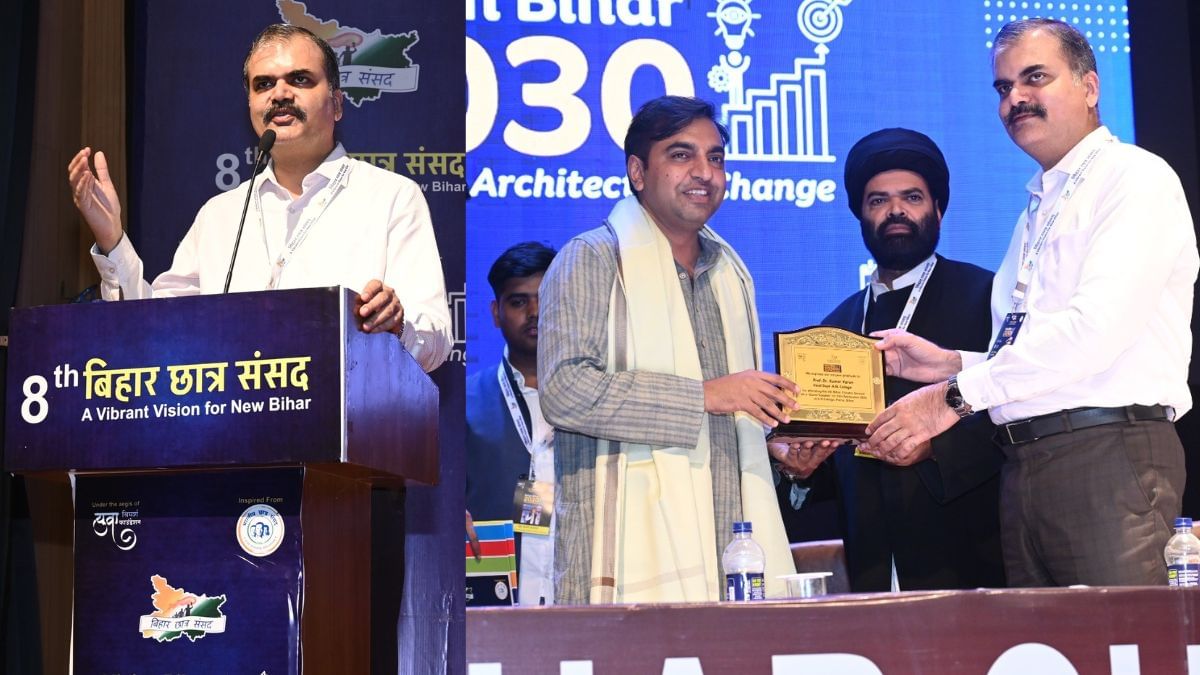
The 8th Bihar Student Parliament convened at Anugrah Narayan College in Patna, fostering discussions on state development. The event was organized by Ankit Kumar and saw the presence of Minister Nitin Naveen of the Bihar government as the chief guest. Notable attendees included Maulana Kalbe Rushaid Rizvi, Ratnesh Kushwaha, Rahul Jha, IPS Vikas Vaibhav, Varun Kumar, advocate Kumar Shanu, and a diverse group of talented young individuals representing various parts of the state.
During his address, IPS Vikas Vaibhav stressed that Bihar’s progress is crucial for the overall development of India. He argued that Bihar’s development is a prerequisite for India to achieve developed nation status by 2047. He believes that empowering the youth with educational and employment opportunities within Bihar is key to the state’s growth.
**Bihar’s Annual Per Capita Income Stands at ₹76,490**
The event highlighted that Bihar is experiencing rapid economic advancement, drawing from recent data released by the Ministry of Statistics and Programme Implementation. The state’s growth rate is recorded at 8.64 percent at constant prices and 13.09 percent at current prices, ranking second in the nation. Per capita income has increased from ₹68,624 in the fiscal year 2023-24 to ₹76,490 in the fiscal year 2024-25.
**Bihar’s Monthly Per Capita Income Lags Behind**
IPS Vikas Vaibhav also pointed out that Bihar lags behind the national average in monthly per capita income. The average monthly income per capita in Bihar is ₹6,374, while Delhi’s is ₹46,060, Telangana’s is ₹35,644, and Karnataka’s is ₹35,154. Bihar also trails neighboring states like Jharkhand (₹10,687) and Uttar Pradesh (₹10,353).
**Projection: ₹12,820 Per Capita Income by 2030**
Vaibhav further indicated that even with a 15 percent growth rate, the per capita income in Bihar in 2030 would be approximately ₹12,820, and in 2035, it would be around ₹25,786, which is still less than what many other states currently have. The gathering also addressed the impact of caste and community-based political dynamics and social fragmentation on the development trajectory.