

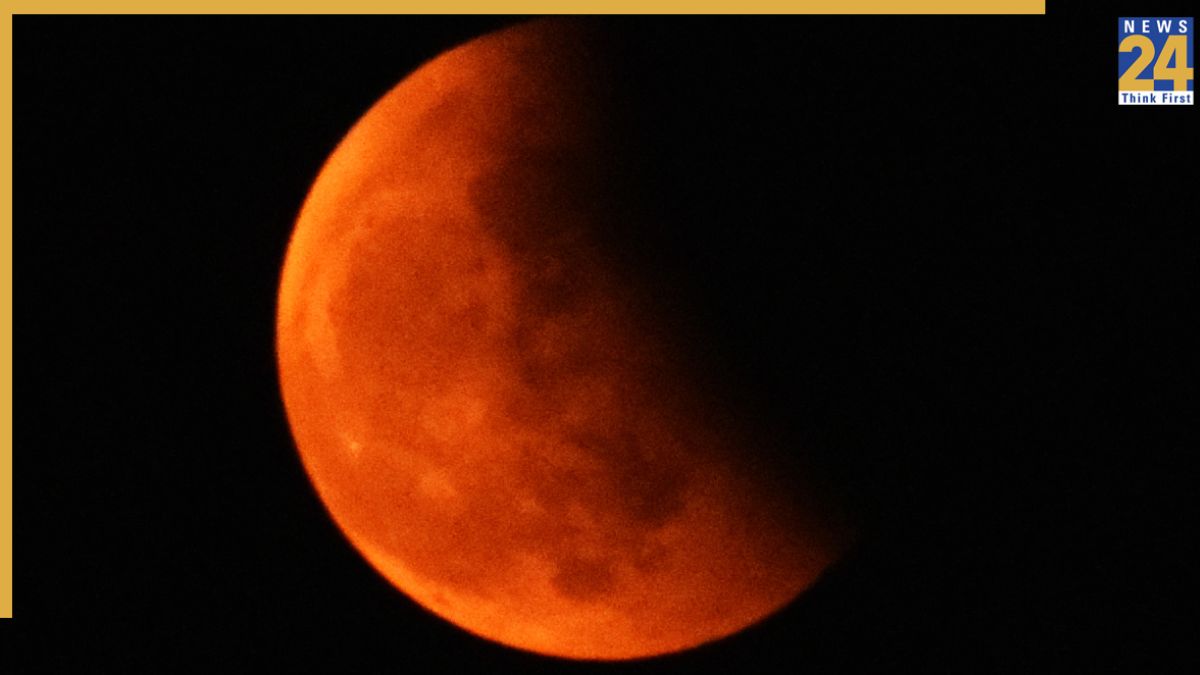
The upcoming month brings the promise of a spectacular astronomical event: a total lunar eclipse. This celestial display, known as a ‘blood moon,’ will be visible across a wide range of locations, including Asia, Africa, the Americas, Europe, and Oceania, offering a rare viewing opportunity for billions worldwide.
The lunar eclipse will begin at 9:57 pm on September 7th, as per Indian Standard Time (IST), and will conclude at 1:26 am on September 8th. The most dramatic phase, when the Moon is entirely within Earth’s shadow, will occur between 11:42 pm and 12:47 am. This totality will cause the Moon to appear red, a visual phenomenon lasting approximately 65 minutes.
A total lunar eclipse is the result of a precise alignment: the Earth positioned directly between the Sun and the Moon. This creates a shadow (the umbra) that falls upon the Moon. As sunlight passes through Earth’s atmosphere, the blue light is scattered, while red light bends and reaches the Moon’s surface, giving it a reddish hue.
In India, this eclipse will be clearly visible in 15 cities, including Delhi, Mumbai, Kolkata, Chennai, Bengaluru, Hyderabad, Pune, Lucknow, Jaipur, Chandigarh, Ahmedabad, Guwahati, Patna, Bhopal, and Bhubaneswar. Local weather conditions may affect the visibility.
In eastern Indian cities such as Kolkata and Guwahati, the beginning of the eclipse will be visible earlier due to the earlier moonrise. In western cities like Mumbai and Ahmedabad, the eclipse will also be observable, but the moonrise will be delayed.
According to Hindu tradition, the Sutak Kaal, a period of impurity, begins nine hours before the eclipse. During this time, temples remain closed. The Sutak Kaal will start at 12:57 pm on September 7th and continue until the eclipse ends on September 8th at 1:26 am. During the Sutak period, many Indians avoid cooking, eating, and performing auspicious tasks. Temples will be reopened on the morning of September 8th, following purification rituals.