

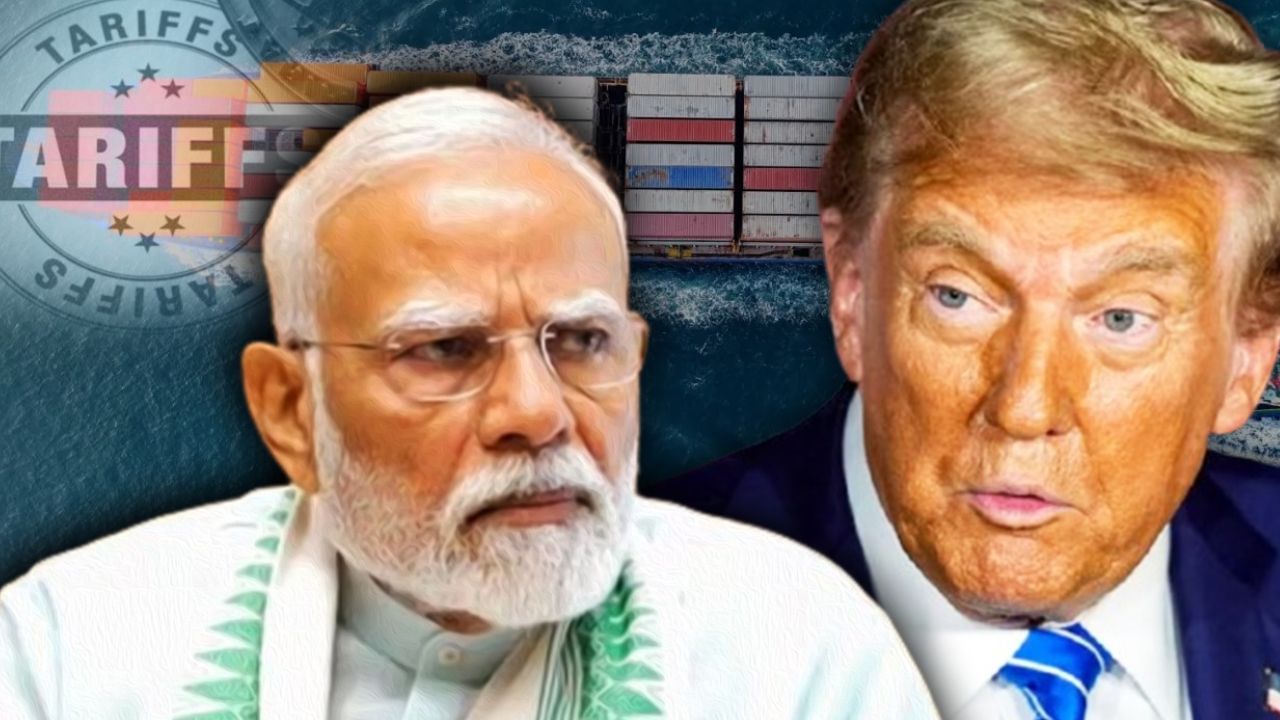
Former President Trump, who pledged to resolve the Russia-Ukraine war rapidly, is now facing the consequences of his unfulfilled promise. The US is now shifting the blame, focusing on India and accusing it of benefiting from Russian oil purchases. As a result, a 50% tariff on Indian goods was imposed on August 27th.
The conflict, which began in February 2022, has resulted in over 400,000 casualties. Russia has suffered approximately 250,000 fatalities, including military personnel, while Ukraine’s death toll exceeds 100,000. The question remains: Why is Trump deflecting responsibility for his failures by focusing on India?
1. Efforts to Influence the European Union
The US seeks to unite European nations in their response to India. However, the EU has remained silent on the matter. Trump’s advisors are using India as a scapegoat by bringing Modi’s role in the war into the discussion.
Trump’s meeting with Russian President Vladimir Putin in Alaska on August 15th did not yield any positive outcomes. This was followed by discussions with Ukrainian President Volodymyr Zelensky and European leaders at the White House on August 18th, which also failed to reach a consensus.
On August 29th, Trump’s trade advisor Peter Navarro stated that the tariffs on India were to prevent the flow of financial aid to Putin’s war efforts. A day earlier, Navarro had described the Russia-Ukraine conflict as ‘Modi’s war,’ suggesting that India was contributing to it through its oil imports.
2. Allegations Against Biden
Trump consistently blames Biden for the start of the war, maintaining that it wouldn’t have begun under his leadership. Despite these claims, he continues to advocate for a peaceful solution, although a swift agreement between Russia and Ukraine seems unlikely. Trump’s special envoy, Steve Witkoff, expressed pessimism about an agreement this year.
Prior to any potential peace agreement, Trump’s team targeted India. Trump’s threats have had little effect on Russia and Ukraine. On August 22nd, Trump set a two-week deadline for peace talks, suggesting that an alternative approach might be necessary if progress was not made.
Trump has set similar two-week deadlines in the past. In May, he warned that any lack of seriousness from Putin regarding a peace agreement would prompt a different response.
3. Pressure on Russia through India
The US is unable to directly pressure Russia, so it attempts to use India as leverage. The tariffs have not been successful. This tactic seems to be backfiring. India is now engaging with 40 countries to counteract the tariffs, seeking to increase the global market access for Indian goods.
American economist Richard Wolf has criticized Trump’s imposition of tariffs on India as a ‘tough guy’ move that is self-defeating. This approach is seen as a way to boost the BRICS nations as an alternative to the West.
Trump advisor Navarro alleges that before the war, India’s Russian oil imports were under 1%, while they are now over 30%, or 1.5 million barrels per day. This increase is not because of domestic demand. However, India claims that it has helped stabilize global oil prices through its Russian oil purchases.