

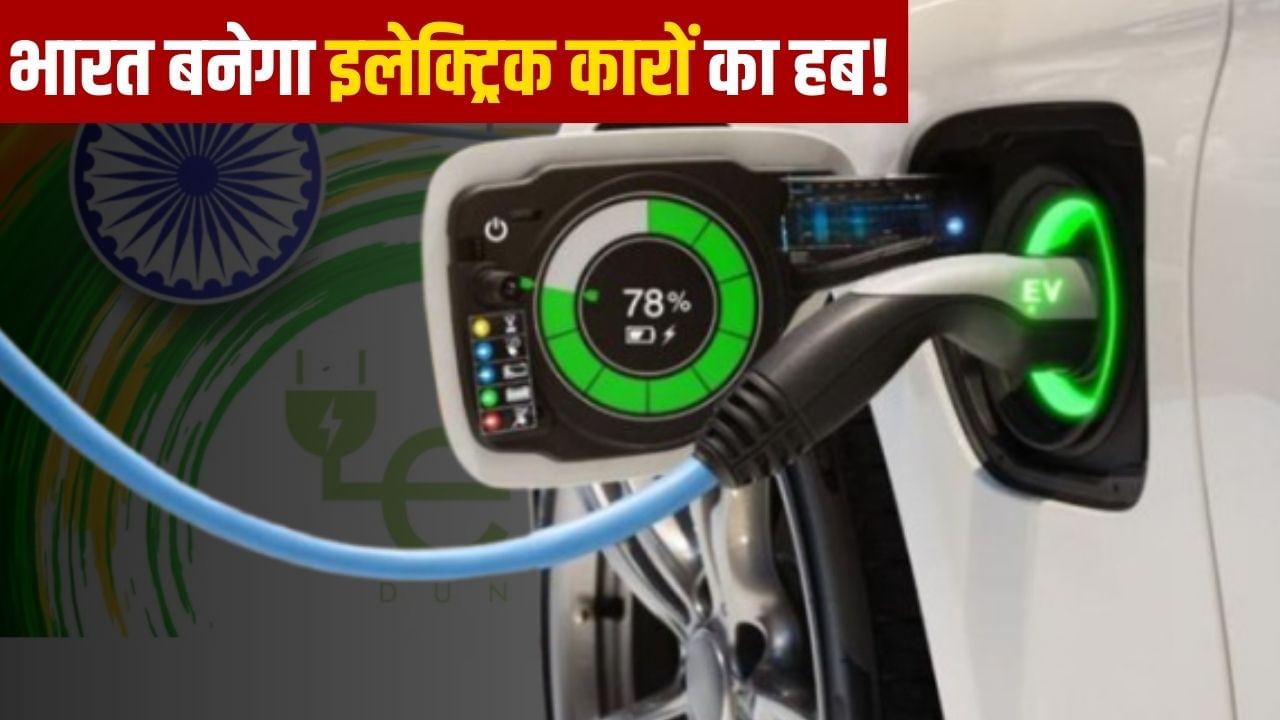
Maruti Suzuki’s e-Vitara, the company’s first electric SUV, has been unveiled in Gujarat. The launch is expected in September in India, with initial exports planned. This vehicle is a significant step for Maruti in the EV market, where Tata and Mahindra currently have a strong presence. According to a report by the Rhodium Group, India’s electric car manufacturing capacity could reach 2.5 million units annually by 2030, which is a tenfold increase from the current 200,000 units. This would make India the fourth-largest EV manufacturer globally, behind China, Europe, and the United States. The report suggests India needs to reduce production costs to be competitive internationally.
The Rhodium report estimates that by 2030, the demand for electric cars in India will be between 400,000 and 1.4 million units. The production capacity is expected to be much higher than the demand, indicating that a large number of EVs will be exported. To achieve this, Indian companies must reduce costs to compete with other global manufacturers. The ‘Make in India for the World’ plan is gaining momentum in the EV sector. Major players like Tata Motors, MG Motor, and Mahindra Motors control nearly 90% of the domestic EV market. However, India needs to focus on cost, technological advancements, and mass production to succeed globally. China has an edge with its low-cost, high-volume EV production. Indian companies must therefore improve their technology, scale up production, and find ways to reduce costs to be competitive internationally.
By 2030, India’s electric vehicle production capacity could reach 2.5 million units, positioning it as the fourth-largest EV manufacturer globally, surpassing Japan and South Korea. Currently, Japan’s capacity is about 1.1 million units and South Korea’s is about 500,000 units. India is currently expanding rapidly, with a production of 200,000 vehicles, and another 300,000 units in the pipeline. In addition, factories are being built for 1.3 million units, and new plans have been announced for 700,000 units, demonstrating rapid growth in India’s EV sector.
India has adopted a strategy to promote electric vehicles, which includes government subsidies to lower prices and a focus on domestic manufacturing. Incentives are provided to battery and component manufacturers, with an emphasis on improving the charging infrastructure. High import duties, from 70% to 100%, on fully assembled foreign EVs have made it difficult for foreign companies to sell directly in India, and this has led to almost all electric vehicles being manufactured by Indian companies.
India is also experiencing rapid growth in battery manufacturing. The country is becoming a key player in battery cell and module production. Projections show that by 2030, India’s battery cell manufacturing capacity could reach 567 GWh. This would rank India fourth globally, after China, the United States, and Europe, and ahead of countries such as Korea, Japan, and Malaysia. However, the Rhodium report cautions that India’s rapid growth depends on projects that are under construction or announced, which could pose risks if these projects are not completed on time.
On the other hand, India’s EV adoption rate is relatively slow. For example, in Vietnam, EV adoption jumped from 3% in 2022 to 17% in 2024. In India, only 2% of cars sold in 2024 were electric. To boost its EV market, India needs clear and consistent government policies. Moreover, vehicle prices and manufacturing costs should be reduced, and the user experience, from driving to charging, must be improved.