

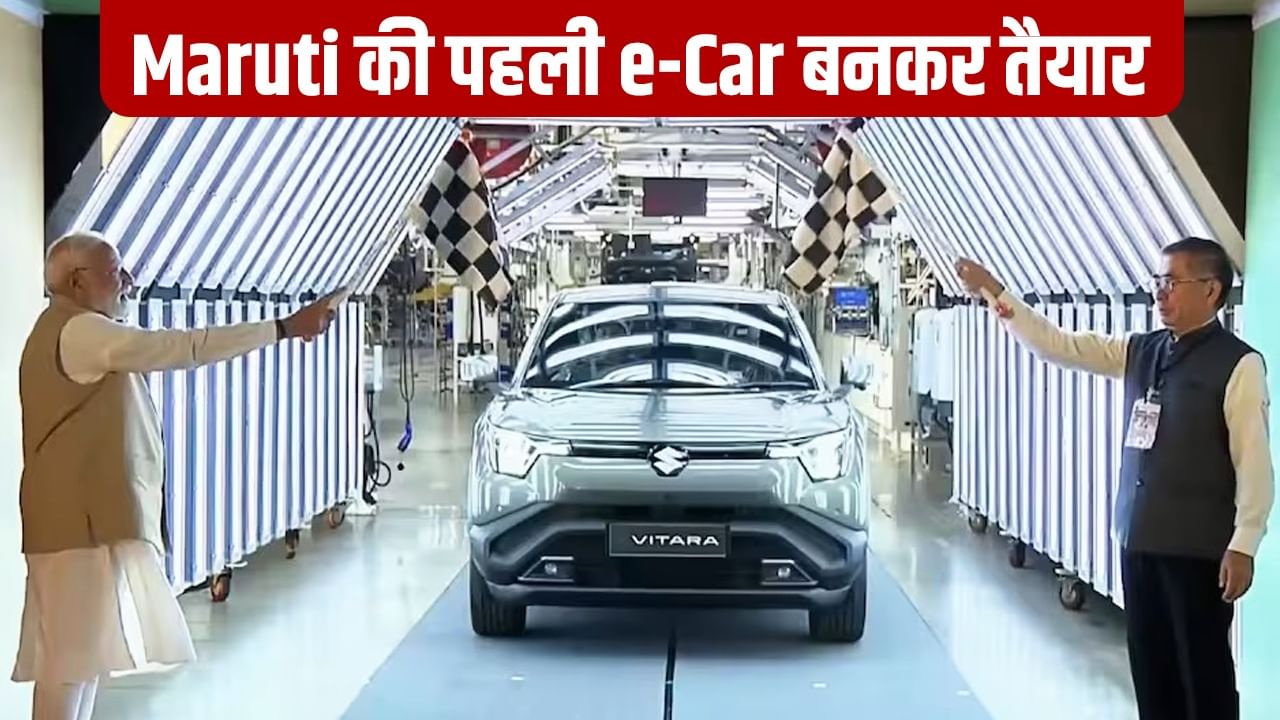
Maruti Suzuki has unveiled its first electric car, the e-VITARA, marking its entry into the EV segment. The e-VITARA was launched from Maruti Suzuki’s plant in Gujarat. While the official launch in India is expected on September 3rd, the initial focus will be on exports to around 100 countries. This launch is significant as it marks Maruti’s initial foray into the electric vehicle market.
In the Indian EV market, companies like Tata, MG, and Mahindra have already established themselves. The key question is: Can Maruti Suzuki, which is entering the market later, compete with these established players?
Electric car sales in India are experiencing rapid growth. In July, the country saw sales of 15,423 electric cars, a 93% increase compared to the previous year. The sales include SUVs, sedans, and MPVs, with SUVs leading the segment. Tata Motors currently dominates the EV market, followed by MG Motors and Mahindra.
Tata Motors is the leader in electric car sales in India. The company also has the largest EV portfolio, with EV versions of most of its models, except for the Altroz. Top-selling electric cars from Tata include the Punch, Nexon, Curve, Tiago, and Tigor, along with the recently launched Harrier. Despite this, Tata’s market share in the EV segment has fallen to 38% from 67% due to increased competition.
JSW MG Motor India secured the second position with sales of 5,061 units, which increased its market share from 16% to 32%. Their product lineup includes the Windsor, Comet, and ZS EV, with the recent introduction of the M9 MPV and Cyberster electric sports car. Mahindra’s electric car sales reached 2,810 units in July, doubling their market share to 17%, with models such as the BE6 and XEV 9e further strengthening their position.
The electric vehicle segment in India is expanding, with 15,000 units sold each month. Maruti Suzuki aims to establish itself in this market. The e-VITARA, an SUV, is positioned to compete with established models like the Hyundai Creta EV, Windsor EV, and Tata Nexon EV. Maruti’s strong reputation in the car market should help the e-VITARA gain traction.
The Maruti electric car is not yet available for sale in India. The company will initially export the ‘Made in India’ electric car. It will be exported to 100 countries, including the UK and Japan. The Maruti Suzuki e-VITARA may be launched in India next month, but it will take time for the car to be seen on the roads. Maruti will focus on the expansion of charging stations and service networks. The company plans to leverage its existing network for ICE cars.
Globally, the e-VITARA comes in two battery pack options: a 49 kWh unit and a 61.1 kWh unit. The 49 kWh battery provides 142 bhp and 193 Nm of torque with a range of up to 344 km. The 61.1 kWh battery is available in front-wheel-drive and all-wheel-drive configurations, with ranges up to 426 km and 395 km, respectively.